
Gentle Exercises for Osteoarthritis Relief in Seniors 65 Plus

Osteoarthritis can make the first few steps out of a chair feel like a negotiation. Your knees may grumble. Your hips may feel tight. Your hands might need a minute before they want to cooperate.
The frustrating part is that resting too much can make stiffness worse. The helpful part is that the right kind of movement can make daily life feel easier.
Gentle exercise won’t “cure” osteoarthritis, but it can support joint movement, build the muscles that protect your joints, improve balance, and help with everyday tasks like climbing stairs, carrying groceries, or getting in and out of the car.
This guide is for safe, low-impact movement. Keep it comfortable, go slowly, and check with a doctor or physical therapist before starting if you’ve had a recent fall, surgery, new swelling, chest pain, dizziness, or a big change in symptoms.

Start with the rules that keep exercise joint friendly
The best exercise plan for osteoarthritis in seniors is the one you can repeat without paying for it the next day.
A little soreness in the muscles can be normal when you’re getting stronger. Sharp pain, joint catching, sudden swelling, or pain that keeps getting worse is different. That’s your cue to stop and get advice.
A simple way to judge intensity is the talk test. During gentle cardio, you should be able to talk in full sentences. You may breathe a little faster, but you shouldn’t feel wiped out.
Use these simple guardrails:
Warm up first
Start with 3 to 5 minutes of easy movement, like marching in place, shoulder rolls, or slow walking around the room.
Move in a comfortable range
You don’t need to force a joint to its limit. Smooth, easy motion counts.
Use support when needed
A sturdy chair, countertop, railing, or walking poles can help you feel steady.
Keep pain mild
Aim for movement that stays in the “comfortable to mildly uncomfortable” range. If pain rises sharply, back off.
Rest on flare-up days
During a flare, focus on gentle range-of-motion exercises rather than strengthening or long walks.
Build slowly
Add time or repetitions a little at a time. More isn’t always better.
Think of exercise as a daily joint care habit, like brushing your teeth. Short sessions work. Five to 10 minutes can still be useful, especially on stiff days.
Walking is simple, but it works
Walking is one of the easiest ways to keep joints moving without special equipment. It helps the hips, knees, ankles, and back stay active. It also supports heart health and balance.
The trick is to make walking gentle enough that you’ll want to do it again tomorrow.
Try this:
Walk for 5 minutes at an easy pace.
Stop before your joints feel irritated.
Add 1 or 2 minutes every few days if you feel good.
Use supportive shoes with good traction.
Choose flat, even paths when possible.
If your knees or hips get cranky, shorten your stride. Smaller steps often feel better than long steps. A cane or walking poles can also reduce stress on painful joints when used correctly.
Indoor walking counts too. Walk a hallway, circle the kitchen, or use a store or community center when the weather is bad. The goal isn’t speed. The goal is regular, comfortable movement.
Water exercise can feel easier on sore joints
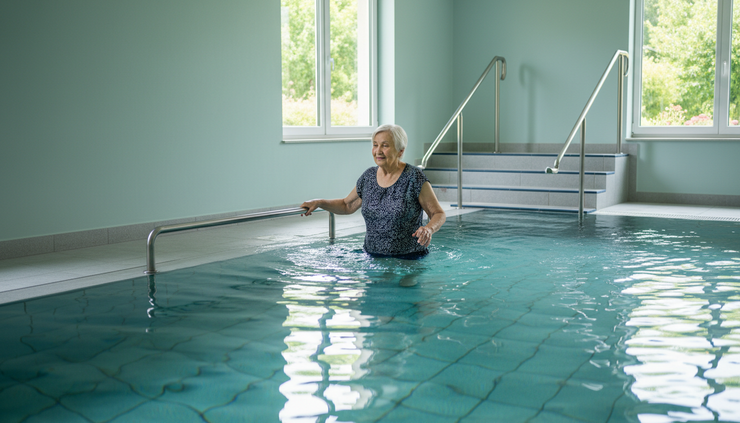
If you have access to a pool, water exercise is hard to beat. The water supports part of your body weight, which can make movement feel easier on painful hips, knees, and feet.
You don’t have to swim laps. In fact, many people with osteoarthritis do better with simple standing movements in chest-deep water.
Good options include:
Walking forward and backward in the pool
Side-stepping along the wall
Gentle knee bends
Leg swings while holding the pool edge
Slow arm circles under the water
Start with 10 to 15 minutes if that feels manageable. Keep movements slow and controlled. Water adds resistance, so even easy moves can strengthen muscles.
If a pool deck feels slippery or getting in and out of the pool is difficult, look for pools with handrails, ramps, or warm-water classes designed for arthritis.
Range-of-motion exercises help with stiffness
Range-of-motion exercises move a joint through a comfortable path. They’re especially helpful in the morning, after sitting, or during times when stronger exercise feels like too much.
Keep them slow. No bouncing. No forcing.
Neck and shoulder rolls
Sit tall in a sturdy chair. Relax your shoulders.
Slowly turn your head to look over one shoulder.
Return to center.
Turn toward the other shoulder.
Repeat 5 times each way.
Then roll your shoulders up, back, and down. Do 5 slow circles, then switch direction.
This can help loosen the upper back and shoulders, especially if you’ve been reading, watching TV, or using a tablet.
Wrist and hand openers
Osteoarthritis in the hands can make buttons, jars, and utensils harder to manage.
Try this gentle hand routine:
Open your hand wide.
Slowly make a loose fist.
Open again.
Repeat 5 to 10 times.
Then touch your thumb to each fingertip, one at a time. Move slowly. If your fingers are stiff in the morning, warming your hands first with warm water may help.
Ankle circles
Sit in a chair with both feet near the floor. Lift one foot slightly.
Circle your ankle 5 times one way.
Circle it 5 times the other way.
Switch sides.
Ankle movement helps with walking comfort and balance. It’s a small exercise, but it matters.
Strength exercises protect the joints
Strong muscles act like helpers for your joints. When the muscles around your knees, hips, shoulders, and core are stronger, your joints don’t have to do all the work.
You don’t need heavy weights. Body weight, light resistance bands, or soup cans can be enough.
Aim for 2 days a week to start, with rest between strength sessions. Keep the effort moderate.
Chair sit-to-stands
This is one of the most practical exercises you can do. It trains the same movement you use all day.
Sit near the front of a sturdy chair.
Place your feet flat on the floor, about hip-width apart.
Lean forward slightly from the hips.
Stand up slowly.
Sit back down with control.
Try 5 repetitions. Use your hands on the chair arms if needed. As you get stronger, use your hands less.
If your knees hurt, check your foot position. Keep your knees pointing in the same direction as your toes. Don’t let them collapse inward.
Straight leg raises
This exercise can strengthen the front of the thigh without bending the knee much.
Lie on your back with one knee bent and the other leg straight.
Tighten the thigh muscle of the straight leg.
Lift the straight leg a few inches.
Hold for 2 seconds.
Lower slowly.
Try 5 to 10 repetitions on each side.
Keep the movement small and controlled. If lying on the floor isn’t comfortable, ask a physical therapist for a chair or bed version.
Wall pushups
Wall pushups strengthen the chest, arms, and shoulders with less strain than floor pushups.
Stand facing a wall.
Place your hands on the wall at chest height.
Step your feet back a little.
Bend your elbows and bring your chest toward the wall.
Push back to the starting position.
Try 5 to 10 repetitions.
Stand closer to the wall to make it easier. Step farther back to make it more challenging, as long as it still feels safe.
Side leg raises
This move supports hip strength, which can help with walking and balance.
Stand behind a sturdy chair and hold the backrest.
Keep your body tall.
Slowly lift one leg out to the side.
Keep your toes facing forward.
Lower with control.
Try 5 repetitions on each side.
Don’t lean your torso to the opposite side. A small lift is fine. Control matters more than height.

Balance exercises help you move with confidence
Osteoarthritis can change how you walk, especially if one joint hurts more than another. That can affect balance. Gentle balance practice helps train your body to feel steadier.
Always do balance exercises near a countertop, sturdy chair, or wall.
Heel-to-toe standing
Stand near a counter. Place one foot directly in front of the other, as if standing on a line.
Hold for 10 seconds. Switch feet.
Use one or two hands for support. If that feels easy, use just a fingertip. If it feels too hard, place your feet slightly apart instead of heel-to-toe.
Marching in place
Stand tall and hold a counter or chair.
Lift one knee a little, then lower it. Lift the other knee. Keep going slowly for 10 to 20 steps.
This helps with hip strength, coordination, and walking confidence. Keep the knee lift small if your hips or knees are sore.
Gentle tai chi
Tai chi uses slow, flowing movements. Many people like it because it blends balance, strength, breathing, and focus. Look for beginner classes, senior center programs, or online videos made for older adults.
Start with a short session. Choose movements that don’t require deep knee bends or twisting. If a movement bothers your joints, skip it.
Stretching can ease tight muscles around sore joints
Stretching doesn’t need to be intense. In fact, gentle is better. Tight muscles can pull on joints and make movement feel harder, so a few calm stretches can help you feel looser.
Hold each stretch for about 10 to 30 seconds. Breathe normally. Stop if you feel sharp pain, numbness, or tingling.
Calf stretch
Stand facing a wall. Place both hands on the wall.
Step one foot back. Keep that heel down and the back knee straight. You should feel a gentle stretch in the calf.
Switch sides.
This can be helpful if your ankles feel stiff or your stride has gotten shorter.
Hamstring stretch
Sit near the edge of a chair. Keep one foot flat. Extend the other leg forward with the heel on the floor.
Sit tall and lean forward slightly from the hips. Keep your back long. You should feel a gentle stretch behind the thigh.
Switch sides.
Avoid rounding your back or forcing the stretch.
Chest opener
Sit or stand tall. Bring your shoulder blades gently back and down, as if you’re trying to widen your collarbones.
Hold for a few breaths.
This is a nice stretch after reading, driving, knitting, or using a phone.
A simple weekly plan that won’t wear you out
You don’t need a complicated schedule. A steady mix of movement, strength, balance, and stretching works well for many people.
Here’s a gentle example:
Day | Gentle plan |
Monday | 10-minute walk, hand exercises, calf stretch |
Tuesday | Chair sit-to-stands, wall pushups, ankle circles |
Wednesday | Water walking or easy indoor walking |
Thursday | Range-of-motion routine and balance practice |
Friday | Short walk, side leg raises, hamstring stretch |
Saturday | Gentle tai chi or pool movement |
Sunday | Rest day with light stretching if it feels good |
Adjust the plan to match your joints. If 10 minutes is too much, start with 3. If mornings are painful, try movement later in the day. If one exercise doesn’t feel right, choose another.
The best plan is not the hardest one. It’s the one you can keep doing.
When to skip exercise and call for help
Some discomfort with osteoarthritis is common, but certain symptoms deserve attention.
Pause exercise and call a healthcare professional if you notice:
New or sudden joint swelling
Pain that is sharp, severe, or unusual for you
A joint that feels hot or very red
Dizziness, chest pain, or shortness of breath
A recent fall or injury
Pain that lasts more than a day or two after gentle activity
Also ask for help if fear of falling keeps you from moving. A physical therapist can suggest safe exercises, check your walking pattern, and help you choose the right support.
If you’d like more help building a routine that fits your needs, you can explore senior coaching plan options and choose the level of support that feels right.
FAQ
What is the best exercise for osteoarthritis?
There isn’t one best exercise for everyone. Walking, water exercise, strength training, stretching, and range-of-motion exercises can all help. The best choice is the one that feels safe, comfortable, and repeatable.
Should I exercise when my joints hurt?
Mild stiffness often improves with gentle movement. Sharp pain, new swelling, or worsening pain is a sign to stop. On flare-up days, stick with easy range-of-motion exercises or rest.
How often should seniors with osteoarthritis exercise?
Many people do well with some gentle movement most days and strength exercises about 2 days a week. Start smaller if needed. Even 5 minutes can be a good beginning.
Are chair exercises enough?
Chair exercises can be very useful, especially for strength, flexibility, and confidence. If walking or standing is hard, chair routines are a safe place to start.
Can exercise make osteoarthritis worse?
Exercise that is too hard, too sudden, or painful can irritate joints. Gentle, low-impact exercise done at the right level usually supports joint health and daily function.

Keep it gentle and keep it going
Osteoarthritis can make movement feel less inviting, but your joints still need motion. Start small. Choose exercises that feel kind. Give your body time to adapt.
A short walk, a few chair sit-to-stands, ankle circles during TV, or gentle hand exercises after breakfast all count. Done regularly, these small moves can help you feel steadier, looser, and more confident in daily life.
This article is for general information only and isn’t a substitute for personal medical advice. If you’re unsure where to start, ask your doctor or a physical therapist for guidance tailored to your joints.


Comments