
How Seniors Can Strengthen Ankles for Better Balance

A wobbly step can make the whole day feel smaller. Maybe the curb feels higher than it used to. Maybe turning around in the kitchen takes a little more thought. A lot of balance trouble starts lower than people expect, right at the ankles.
Your ankles do more than move your feet. They help you sense the ground, adjust your body weight, and catch small shifts before they turn into a stumble. The good news is that ankle strength and control can improve with simple practice, and you don’t need fancy equipment to start.
This guide walks through safe, practical ways to build stronger ankles for steadier walking, easier standing, and more confidence around the house and out in the world.
This is general information, not medical advice. If you’ve had a recent fall, ankle injury, surgery, numbness, severe arthritis, dizziness, or a medical condition that affects balance, check with a doctor or physical therapist before starting.

Why your ankles matter so much for balance in seniors
Think of your ankles like the small steering wheels of your body. They make quick corrections all day long. When you stand in line, step onto grass, or turn to reach into a cabinet, your ankles help keep your weight centered.
As the years go by, a few things can make that harder:
Ankles may lose some range of motion
Calf and foot muscles may get weaker
Feet may become less sensitive to changes in the ground
Old sprains or injuries may leave one side less steady
Shoes, pain, or stiffness may change how you walk
Balance isn’t only about muscle. It also uses your eyes, inner ear, nerves, joints, and brain. Still, ankle strength gives the whole system a better base to work from.
Stronger ankles can help with everyday tasks like:
Getting out of a chair
Walking on uneven sidewalks
Going up and down steps
Standing at the sink
Turning safely in a small space
Recovering from a small trip or misstep
You’re not trying to become an athlete here. You’re teaching your ankles to be more awake, steady, and reliable.
Start with safety before you exercise
Ankle exercises for balance for seniors should feel controlled, not scary. Before you begin, set things up so you can focus on the movement instead of worrying about falling.
Choose a spot with:
A sturdy counter, railing, or heavy chair nearby
Good lighting
A flat floor
Supportive shoes, unless your doctor or therapist has told you otherwise
No loose rugs, cords, pets, or clutter around your feet
Keep a phone nearby, especially if you live alone.
Use this simple rule: mild effort is fine, sharp pain is not. Stop if you feel chest pain, strong dizziness, sudden shortness of breath, or pain that feels new or intense.
If one ankle is much weaker than the other, work both sides, but go slower on the weaker side. It’s normal for one side to feel less coordinated.
Warm up your ankles before strengthening
Cold, stiff joints don’t love sudden exercise. A short warm-up helps your ankles move better and can make the rest of the routine feel easier.
Try this for 3 to 5 minutes.
March in place while holding on
Stand near a counter. Hold it lightly with both hands. March slowly in place.
Lift each foot only as high as feels comfortable. Keep your steps soft and steady.
Do this for 30 to 60 seconds.
Make ankle circles
Sit in a sturdy chair. Lift one foot slightly off the floor. Slowly circle the ankle 10 times in one direction, then 10 times the other way.
Switch feet.
Don’t rush this. Smooth circles teach the joint to move in more directions.
Write the alphabet with your toes
Stay seated. Imagine your big toe is a pencil. Write the alphabet in the air with one foot.
You don’t have to make huge letters. Small, controlled movement works well.
Switch to the other foot.
This is a nice one because it moves the ankle forward, backward, side to side, and in circles.

Build ankle strength with simple exercises
Do these exercises 3 to 5 days per week. Start with one set. If it feels easy after a week or two, add a second set.
Move slowly. The lowering part matters just as much as the lifting part.
Raise your heels
This strengthens the calf muscles and the muscles around the back of the ankle.
Stand behind a sturdy chair or at a counter.
Hold on with both hands.
Rise up onto the balls of your feet.
Pause for one second.
Slowly lower your heels.
Try 8 to 12 repetitions.
If standing feels too hard, do it seated first. Sit tall, keep your toes on the floor, lift your heels, then lower them.
When you get stronger, try holding on with just one hand. Don’t rush to make it harder. A smooth motion is the goal.
Lift your toes
This works the front of the lower leg, which helps your foot clear the ground when you walk.
Stand with your back near a wall or hold a counter.
Keep your heels on the floor.
Lift your toes toward your shins.
Lower them slowly.
Try 8 to 12 repetitions.
This one can feel surprisingly tiring. That’s okay. Those small muscles often need attention.
Turn your soles inward and outward
These movements strengthen the side muscles that help your ankle react when the ground isn’t perfectly flat.
Sit in a chair with both feet on the floor.
For inward movement:
Keep your heel down.
Gently turn the sole of one foot toward the other foot.
Return to center.
For outward movement:
Keep your heel down.
Gently turn the sole away from the other foot.
Return to center.
Try 8 to 10 each way on each foot.
Keep the motion small and controlled. Don’t force it.
Use a resistance band if you have one
A resistance band can help strengthen the ankle in all directions. Use a light band at first.
For pushing down:
Sit with one leg out in front.
Loop the band around the ball of your foot.
Hold the ends in your hands.
Point your toes away from you.
Slowly return.
For pulling up:
Tie or secure the band around a sturdy object.
Loop it over the top of your foot.
Pull your toes toward your shin.
Slowly return.
You can also use the band for gentle inward and outward ankle turns.
Try 8 to 12 repetitions each direction.
If the band snaps, slips, or makes you strain, stop and reset. The exercise should feel steady, not like a tug-of-war.
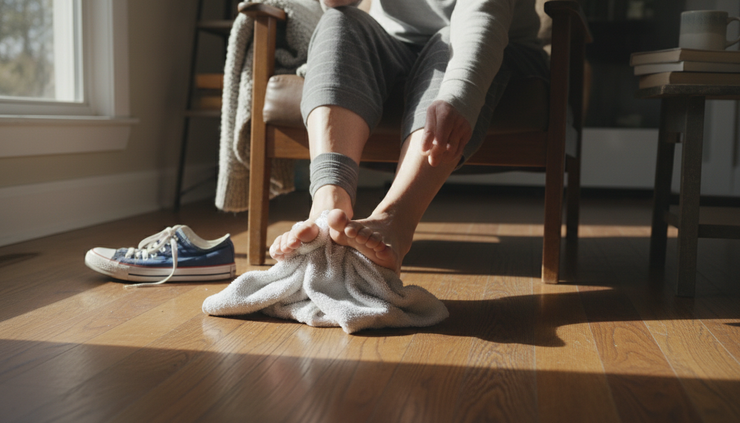
Scrunch a towel with your toes
This strengthens small muscles in the feet that support balance.
Sit in a chair.
Place a small towel flat under one foot.
Use your toes to scrunch the towel toward you.
Smooth it back out and repeat.
Try 3 to 5 towel scrunches per foot.
This may feel awkward at first. That’s normal. Small foot muscles often need a little reminding.
Train your ankles to react better
Strength is only part of the story. Your ankles also need practice sensing changes and making quick, tiny corrections. This is called proprioception, which is your body’s sense of position.
These balance drills should be done near a counter or sturdy chair. Keep your fingertips on the surface at first. As you improve, use a lighter touch.
Stand with your feet closer together
Start with both feet hip-width apart. Stand tall and breathe normally.
Then bring your feet a little closer. Hold for 10 to 20 seconds.
If that feels steady, bring your feet together. Hold for 10 to 20 seconds.
Keep your eyes open. Don’t try eyes-closed balance unless a professional tells you to.
Practice a heel-to-toe stance
Stand near the counter. Place one foot slightly in front of the other, like you’re standing on a narrow path.
You don’t have to line them up perfectly. A small stagger is fine.
Hold for 10 to 20 seconds. Switch which foot is in front.
If this feels too easy, move your feet a little closer to a true heel-to-toe position.
Shift your weight side to side
Stand with feet hip-width apart. Hold the counter lightly.
Shift your weight toward your right foot without lifting the left foot. Come back to center. Then shift left.
Try 10 slow shifts each way.
This teaches your ankles to manage weight changes, which happens constantly when you walk.
Try supported single-leg standing
This is one of the most useful balance exercises, but it should be done carefully.
Stand at a counter.
Hold on with both hands.
Lift one foot just an inch off the floor.
Hold for 5 to 10 seconds.
Switch sides.
Do 2 to 3 rounds per side.
If that’s too hard, keep the toes of the lifted foot touching the floor like a kickstand. You’ll still get practice without feeling unsafe.
Make walking part of the plan
Walking is one of the best ways to use ankle strength in real life. The trick is to walk with attention, not just distance.
Pick a safe route. Good choices include a hallway, indoor track, smooth sidewalk, grocery store aisle, or level park path.
During your walk, notice:
Are your steps even?
Are your toes clearing the floor?
Do you feel steady when you turn?
Are you landing softly?
Are your shoes supporting you well?
If you tend to shuffle, practice taking slightly clearer steps. You don’t need big steps. Just aim for a clean lift and place.
If you use a cane or walker, keep using it as prescribed. Ankle exercises are meant to support safe movement, not replace a needed device.
A simple weekly ankle routine
Here’s an easy plan to follow. It takes about 10 to 15 minutes.
Day | What to do |
Monday | Warm-up, heel raises, toe lifts, weight shifts |
Tuesday | Short walk and ankle circles |
Wednesday | Warm-up, towel scrunches, resistance band work |
Thursday | Rest or gentle walking |
Friday | Warm-up, heel raises, heel-to-toe stance, supported single-leg standing |
Saturday | Short walk and seated ankle alphabet |
Sunday | Rest or repeat favorite gentle moves |
If soreness lasts more than a day or two, reduce the repetitions. If you feel better and steadier, add a little time or one extra set.
Small progress counts. Holding a balance position for 15 seconds instead of 10 is progress. Lowering your heels with more control is progress. Feeling less nervous stepping off a curb is real progress.
Common mistakes that make ankle work less helpful
A few small habits can get in the way. Watch for these.
Holding your breath
Breathe normally while you exercise. Breath-holding can make you tense and less steady.
Rushing the movement
Fast reps often hide weakness. Slow movement builds better control.
Gripping the counter too hard
Hold on for safety, but try not to hang on with your whole body. Let your legs and ankles do some of the work.
Ignoring pain
Muscle effort is fine. Joint pain, sharp pain, swelling, or a feeling that the ankle may give way deserves attention.
Doing too much too soon
More isn’t always better. A short routine done often usually beats a long routine that leaves you wiped out.

When to get extra help
Some balance issues need more than home exercises. Reach out to a healthcare professional if you notice:
A recent fall or repeated near-falls
Dizziness, faintness, or spinning sensations
Numbness or burning in the feet
Swelling that doesn’t improve
Ankle pain that changes your walking
One foot dragging or catching often
Sudden weakness on one side
Fear of walking that keeps you from normal activities
A physical therapist can check your strength, walking pattern, shoes, and balance reactions. They can also tailor exercises to your needs.
If you’d like ongoing support with healthy aging habits, movement goals, and staying consistent, you can explore My Senior Coach plans and choose the level of guidance that fits your routine.
Frequently asked questions
How often should seniors do ankle exercises?
Most people do well with ankle exercises 3 to 5 days per week. Start with 10 minutes. If you feel sore or tired, take a rest day between sessions.
Can ankle exercises really improve balance?
They can help, especially when combined with walking, leg strength, vision care, safe footwear, and fall-prevention habits at home. Ankles are one part of balance, but they’re an important part.
Should I do ankle exercises barefoot or with shoes?
Supportive shoes are usually safer for standing balance exercises. Seated exercises may be comfortable barefoot or in socks, but avoid slippery floors. If you have diabetes, neuropathy, or foot problems, ask your doctor what’s safest.
What if one ankle feels much weaker?
That’s common, especially after an old sprain or injury. Work both sides, but keep the weaker side slow and controlled. If it feels unstable, painful, or swollen, get it checked.
How long before I notice better balance?
Some people feel steadier within a few weeks of regular practice. For others, it takes longer. Look for small signs, like smoother walking, easier turns, or more confidence standing at the counter.

Keep it simple and stay consistent
Strong ankles won’t solve every balance problem, but they can make a real difference in how steady daily life feels. Start with seated movements if standing feels uncertain. Use a counter. Move slowly. Give your body time to learn.
The best routine is the one you’ll actually do. Pick three or four exercises from this guide, practice them a few times this week, and notice how your feet meet the floor. Steadier steps often begin with small, patient work right at the ankles.


Comments