
How Seniors Can Walk Faster and Safely After 60

Walking speed can sneak up on you. One day you’re keeping pace with a friend, and the next you notice you’re the one saying, “Go ahead, I’ll catch up.” The good news is that walking speed isn’t fixed after 60. With the right mix of strength, balance, posture, and practice, most people can build a quicker, steadier stride.
The goal isn’t to rush or turn every walk into a workout. It’s to move with more confidence, cover ground with less effort, and feel safer crossing a parking lot, walking through the grocery store, or enjoying a neighborhood loop.
This guide is informational only and isn’t a substitute for medical advice. If you’ve had recent falls, chest pain, dizziness, new shortness of breath, or a major change in walking ability, check in with a healthcare professional before starting.

Start by finding your comfortable pace for seniors to safely walk
Before seniors should try to walk faster, it helps to know your current pace to walk safely. Keep this simple.
Pick a flat, safe route. Walk for 5 minutes at your normal speed after a gentle warm-up. Notice a few things:
Can you talk in full sentences?
Do your feet feel steady?
Are you leaning forward or looking down?
Do your hips, knees, or feet ache?
Do you feel tired right away, or only near the end?
You don’t need a fancy device. A watch, phone timer, or fitness tracker is fine. You can also use landmarks. For example, time how long it takes to walk from one corner to the next, then repeat that same stretch once a week.
A better walking pace should feel smooth, controlled, and repeatable. If faster walking makes you shuffle, wobble, or gasp for air, slow down and build the pieces first.
Fix the stride before you add speed
Many people try to walk faster by taking bigger steps. That often backfires. Long steps can make the heel hit too far in front of the body, which acts like a brake. It can also bother the knees, hips, or lower back.
A faster, safer walk usually comes from a slightly quicker step rhythm and better posture.
Try this on your next walk:
Stand tall, like someone gently lifted the crown of your head.
Look about 10 to 20 feet ahead, not straight down.
Keep your shoulders relaxed.
Let your arms swing naturally from the shoulders.
Take steps that land under you, not way out in front.
Push gently through the ball of the back foot.
That last part matters. Walking speed comes from the push behind you, not from reaching forward.
Here’s a quick check. If your feet slap the ground or your steps sound heavy, soften your landing. If your arms barely move, let them swing a little more. Your arms help set the rhythm for your legs.
Small posture changes can make walking feel easier almost right away.
Build the muscles that make walking faster
Walking is a whole-body movement, but a few muscle groups do a lot of the work. After 60, strength training becomes one of the best ways to protect your walking speed. You don’t need a gym. A sturdy chair, a wall, and a little floor space can do plenty.
Aim for strength work 2 or 3 days per week, with a day of rest between harder sessions.
Practice sit-to-stands
This is one of the most useful exercises for daily life. It builds the thighs, hips, and glutes, which help you get up from chairs and push forward while walking.
How to do it:
Sit near the front of a sturdy chair.
Place your feet flat and hip-width apart.
Stand up without using your hands if you can.
Sit back down slowly.
Repeat 6 to 10 times.
If that’s too hard, use your hands lightly. If it’s easy, slow down the lowering part.
Do heel raises
Calf strength helps with push-off. That push is a big part of walking faster.
How to do it:
Stand behind a chair or near a counter.
Hold on lightly.
Rise onto the balls of your feet.
Lower slowly.
Repeat 8 to 12 times.
Keep the movement controlled. Don’t bounce.
Add side steps
The muscles along the sides of your hips help keep you steady. They’re especially useful when the sidewalk is uneven or you need to step around something.
How to do it:
Stand tall near a counter if you need support.
Step sideways 5 to 8 steps.
Step back the other way.
Keep your toes facing forward.
You should feel the outer hips working, not the lower back.
Train your balance so speed feels safe
If your body doesn’t trust your balance, it won’t let you pick up the pace. That’s not weakness. That’s your nervous system being protective.
Balance improves with practice, but safety comes first. Always do balance exercises near a counter, sturdy chair, or wall.
Try these a few times a week.
Stand with one foot in front
Place one foot slightly in front of the other, like you’re standing on train tracks instead of a tightrope. Hold for 10 to 20 seconds. Switch sides.
If that feels easy, bring the feet a little closer together.
Practice weight shifts
Stand with feet hip-width apart. Shift your weight gently to the right foot, then to the left. Keep both feet on the floor.
This teaches control. Control helps you recover if you step on a crack or bump.
Walk with gentle head turns
On a safe, flat path, walk slowly while turning your head slightly right and left. This helps because real walking rarely happens while staring straight ahead. You look at cars, shelves, people, pets, and curbs.
Keep it small. If it makes you dizzy, stop and talk with a healthcare professional.
Use intervals to improve speed without overdoing it
You don’t have to walk fast the whole time. In fact, short bursts are often better. They let you practice speed while keeping the walk manageable.
Here’s a simple interval walk:
Part of the walk | What to do | How it should feel |
Warm-up | Walk easy for 5 minutes | Comfortable and loose |
Speed practice | Walk faster for 30 seconds | Brisk but controlled |
Recovery | Walk easy for 90 seconds | Breathing settles |
Repeat | Try 4 to 8 rounds | Stop before form falls apart |
Cooldown | Walk easy for 5 minutes | Calm and steady |
During the faster parts, think “quick and light,” not “big and hard.”
If 30 seconds feels like too much, start with 10 or 15 seconds. If it feels easy after a couple of weeks, add one more round before making the fast parts longer.
A good rule is to finish feeling like you could have done a little more. That helps you come back again tomorrow.
Pay attention to the ground, shoes, and weather
Speed and safety go together. A fast walk on a cracked sidewalk in poor shoes isn’t a win.
Choose routes that help you succeed:
Flat sidewalks or paved trails
Good lighting
Plenty of places to rest
Low traffic crossings
Smooth surfaces without loose gravel
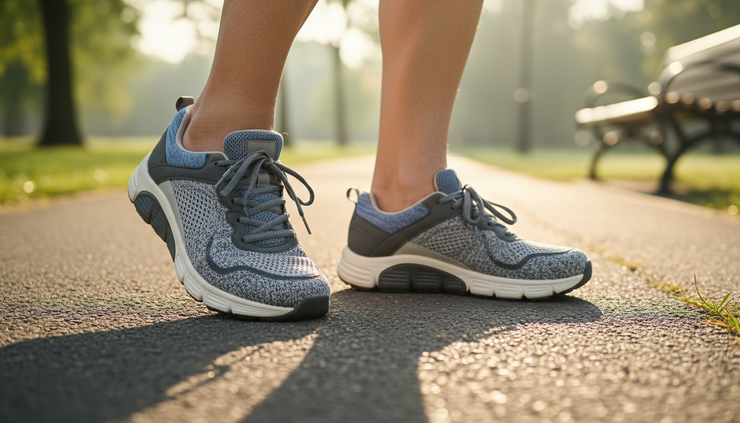
Shoes matter too. Look for a pair that feels secure at the heel, roomy at the toes, and stable under your foot. If the soles are worn unevenly or the tread is smooth, it may be time to replace them.
Be extra careful in rain, ice, heat, or high humidity. On those days, walk indoors at a mall, community center, indoor track, or even a large store. Safety counts more than hitting a pace goal.

Warm up before you ask for more speed
Cold muscles and stiff joints don’t love sudden speed. Give your body a few minutes to get ready.
Before a brisk walk, try this:
Walk slowly for 3 to 5 minutes.
Roll your shoulders a few times.
Do 5 gentle heel raises.
Take 10 easy marching steps in place.
Start your brisk pace gradually.
After the walk, slow down for a few minutes instead of stopping all at once. If your calves or hips feel tight, do gentle stretches while holding onto something stable.
The warm-up doesn’t need to be long. It just needs to be consistent.
Make your walking plan realistic
A plan works best when it fits your life. If it feels too big, it won’t last. Start with what you can repeat.
Here’s a simple weekly plan:
Day | Focus | Example |
Monday | Easy walk | 15 to 30 minutes at a comfortable pace |
Tuesday | Strength | Sit-to-stands, heel raises, side steps |
Wednesday | Interval walk | Short faster bursts with easy recovery |
Thursday | Rest or gentle movement | Light stretching or casual walking |
Friday | Strength | Repeat Tuesday’s exercises |
Saturday | Longer walk | Comfortable pace on a safe route |
Sunday | Balance | Weight shifts, staggered stance, easy walk |
You can move the days around. The main idea is to include walking, strength, balance, and recovery each week.
If you miss a few days, don’t try to make up for all of it at once. Just restart with an easy walk. Consistency beats catching up.
Know when to slow down or stop
A little effort is normal. Pain or alarming symptoms are not.
Slow down or stop if you notice:
Chest pressure or chest pain
Dizziness or feeling faint
New or unusual shortness of breath
Sharp joint pain
Numbness or weakness on one side
A feeling that you may fall
Pain that changes your walking form
If symptoms are serious, sudden, or don’t go away with rest, seek medical help.
For everyday soreness, use common sense. Muscles may feel worked after strength exercises or brisk walking. Joints should not feel worse and worse over time. If knee, hip, back, or foot pain keeps showing up, a physical therapist or clinician can help you adjust the plan.
Track progress without obsessing over numbers
Walking faster should make life feel easier, not turn every walk into a test.
Pick one or two ways to track progress:
Time the same short route once a week.
Count how many fast intervals you can do with good form.
Notice whether hills or parking lots feel easier.
Track how long you can walk before needing a break.
Pay attention to confidence on curbs, turns, and uneven ground.
Progress may show up as speed, but it may also show up as steadier steps, better posture, or less fatigue. Those wins count.
If you like support and want help building a plan that fits your pace, goals, and comfort level, you can explore My Senior Coach pricing plans.

FAQ
How long does it take to improve walking speed after 60?
Many people notice small changes within a few weeks if they practice regularly. Bigger changes usually take longer. Strength, balance, and confidence all build over time, so steady practice matters more than rushing.
Is it better to walk longer or faster?
Both can help, but they do different jobs. Longer easy walks build endurance. Short faster intervals train speed. A mix of both is usually best, as long as your body tolerates it well.
Should I use a cane or walking poles?
Use the support that helps you walk safely. A cane, walker, or walking poles can improve confidence and stability for some people. Make sure the device is the right height and that you know how to use it correctly.
What’s the safest way to start if I haven’t exercised in years?
Start with short, easy walks on flat ground. Even 5 to 10 minutes can be a good beginning. Add time first, then add short faster bursts later. If you have medical concerns, check with your healthcare provider before increasing effort.
Why do I feel slower even though I walk often?
Walking often helps, but speed also depends on leg strength, balance, posture, flexibility, vision, footwear, pain, and confidence. If you always walk at the same easy pace, your body may need gentle speed practice and strength work to get faster.
The takeaway
You can walk faster after 60 without pushing yourself into risky territory. Start with posture. Add strength. Practice balance. Use short speed intervals. Choose safe routes and shoes that support you.
A better pace doesn’t come from forcing longer steps. It comes from feeling steady, strong, and confident enough to move a little quicker. Keep it simple, keep it safe, and give your body time to respond.


Comments