
How to Start Exercising After 60 Even If You Haven't Been Active for Years

Getting back to exercise after a long break can feel like standing at the bottom of a hill and wondering who moved the top farther away.
The good news is that you don’t need a gym membership, fancy shoes, or the same body you had at 35. You need a safe starting point, a little patience, and a plan that doesn’t punish you for being out of practice.
After 60, exercise isn’t about proving anything. It’s about making daily life easier: getting out of a chair with less effort, carrying groceries, climbing steps, sleeping better, and feeling steadier on your feet.
This guide is informational only and isn’t a substitute for medical advice. If you have heart disease, chest pain, dizziness, severe joint pain, breathing issues, recent surgery, or any condition that affects movement, check with your doctor before starting.

Before You Begin: Talk With Your Doctor First
Before starting any new exercise program after age 60, it’s important to check in with your doctor.
A quick conversation can help you understand any limitations, medications, or conditions that might affect how you exercise.
Your doctor can also give you guidance on what intensity is safe for you, especially if you’re dealing with arthritis, balance issues, heart concerns, or if you haven’t exercised in a long time.
This simple step helps you begin your fitness journey with confidence, safety, and peace of mind.
Get a quick safety check before you push yourself
Most people can begin with gentle movement, but it’s smart to be careful. Before you increase your activity, think through a few basic safety questions.
Call your doctor or care team first if you:
Feel chest pain, pressure, or tightness during activity
Get dizzy, faint, or unusually short of breath
Have uncontrolled blood pressure or blood sugar concerns
Recently had a fall, surgery, or hospital stay
Have new swelling, numbness, or sharp pain
Take medications that affect balance or heart rate
This doesn’t mean exercise is off the table. It just means your plan may need a little adjusting.
You might need seated exercise, supervised physical therapy, a walker-friendly walking plan, or limits on certain movements. That’s still progress.
When in doubt, start with movements that let you hold on to something stable, like a kitchen counter, sturdy chair, or railing. Skip anything that feels risky or makes you rush.
Start smaller than you think you should
The biggest mistake is trying to “get in shape” all at once.
If you haven’t moved much in years, your muscles, joints, heart, lungs, and balance all need time to wake up. That’s normal. A short, easy start is not a failure. It’s the smartest way in.
A good first workout might be:
Walking around the house for 3 minutes
Standing up from a chair 5 times
Marching in place while holding the kitchen counter
Stretching your calves while waiting for coffee
Taking one slow walk to the mailbox and back
That counts.
Really.
The goal at first is consistency, not intensity. You’re teaching your body that movement is safe again. Once that feels normal, you can add more.
A simple way to begin is the “two-minute rule.” Pick one movement and do it for just 2 minutes a day for the first week. If you feel good, add another minute the next week.
That may sound too easy, but easy is the point. If the plan feels possible, you’re more likely to repeat it. Repeating it is what changes your body.
Build your routine around four simple types of movement
A balanced exercise plan after 60 doesn’t need to be complicated. Most people do well with four kinds of movement.
Type of movement | What it helps with | Easy starting idea |
Walking or light cardio | Heart, lungs, energy, stamina | Walk 3 to 5 minutes at an easy pace |
Strength | Muscles, bones, getting up from chairs | Sit-to-stands from a sturdy chair |
Balance | Fall prevention, confidence | Stand near a counter and shift weight side to side |
Flexibility | Stiffness, range of motion | Gentle calf, shoulder, and neck stretches |
You don’t have to do all four every day. In fact, you probably shouldn’t at first.
Try this simple weekly rhythm:
Monday
Short walk plus a gentle stretch
Wednesday
Chair strength exercises
Friday
Short walk plus balance practice
Sunday
Easy stretching or light house movement
That’s enough to begin.

Use the chair as your first piece of exercise equipment
A sturdy chair is one of the best tools for getting active again. It gives support, helps with balance, and makes movement less intimidating.
Choose a chair that doesn’t roll, doesn’t rock, and has a firm seat. Place it on a non-slip surface. If needed, keep it near a wall for extra stability.
Try these beginner-friendly chair exercises.
Sit-to-stands
Sit near the front of the chair with feet flat on the floor. Lean slightly forward, press through your feet, and stand up. Sit back down slowly.
Start with 3 to 5 times.
If it’s hard, use your hands on the chair arms. If it’s easy, cross your arms over your chest or slow down the sitting part.
This movement helps with one of the most practical skills you can train: getting up from a chair, toilet, car seat, or bench.
Seated marching
Sit tall and hold the sides of the chair. Lift one knee, lower it, then lift the other.
Try 10 slow marches total.
This warms up the hips and gets blood moving without asking too much from your balance.
Heel and toe raises
Sit with feet flat. Lift your heels while keeping toes down. Then lift your toes while keeping heels down.
Try 10 of each.
This helps ankles and lower legs, which play a big role in walking and balance.
Seated shoulder rolls
Roll your shoulders up, back, and down. Move slowly. Keep your jaw relaxed.
Try 5 circles backward, then 5 forward.
This is good for stiffness from reading, watching TV, driving, or sitting at a computer.
Make walking easier with the right pace
Walking is one of the simplest ways to rebuild stamina. Still, it can be humbling if you used to walk farther or faster.
Start where you are now, not where you wish you were.
Use the “talk test” to find a safe pace. You should be able to speak in short sentences while walking. If you’re gasping, slow down. If you feel great, don’t rush to prove it. Save a little energy for tomorrow.
Here’s a gentle walking plan for the first month.
Week | Walking goal | How it should feel |
1 | 3 to 5 minutes, 3 days | Very easy |
2 | 5 to 7 minutes, 3 days | Easy |
3 | 7 to 10 minutes, 3 or 4 days | Comfortable |
4 | 10 to 12 minutes, 4 days | Mild effort |
If that’s too much, cut it in half. If it’s too easy, add 1 or 2 minutes, not 20.
A walk inside the house counts. A walk through a grocery store counts. A walk around the block counts. The body doesn’t care if the activity looks impressive. It responds to repeated, steady movement.
Pay attention to pain, but don’t fear every sensation
When you start moving again, you may feel stiff, awkward, or a little sore. That can be normal, especially if muscles haven’t worked much lately.
Sharp pain is different.
Use this simple guide.
Usually okay
Mild muscle soreness the next day
Warmth in working muscles
Slight breathlessness that improves with rest
Stiffness that eases as you move
Slow down or stop
Chest pain or pressure
Dizziness or feeling faint
Sharp joint pain
Pain that changes your walking pattern
New swelling
Shortness of breath that feels unusual
Symptoms that don’t settle after rest
A little effort is fine. Suffering is not required.
If one exercise bothers your knees, hips, shoulders, or back, change it. Try a smaller range of motion, fewer repetitions, a seated version, or a slower pace. Exercise should fit your body, not the other way around.
Add strength without lifting heavy weights
Strength training matters more after 60, not less. Muscle helps with balance, joint support, posture, bone health, and daily tasks. You don’t need heavy dumbbells to start.
Your own body weight is enough.
Try this gentle beginner circuit twice a week, with at least one rest day between sessions.
Chair sit-to-stands
Do 3 to 8 repetitions.
Rest as needed.
Wall push-ups
Stand facing a wall. Place your hands on the wall at chest height. Bend your elbows and bring your chest slightly toward the wall. Push back.
Do 5 to 10 repetitions.
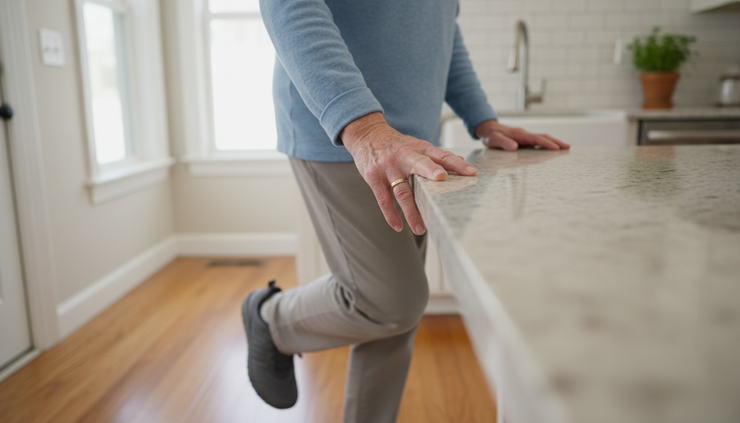
Counter calf raises
Hold the counter lightly. Rise onto your toes, then lower slowly.
Do 5 to 10 repetitions.
Side steps
Hold the counter. Step one foot to the side, then bring the other foot in. Go both directions.
Do 5 steps each way.
One round is enough at first. After a few weeks, you can add a second round if you feel steady and recover well.
Rest is part of training. Muscles get stronger when they have time to recover. If you feel wiped out the next day, do less next time.
Make balance practice a daily habit
Balance can improve with practice. You don’t need anything fancy, and you don’t need to stand on one foot in the middle of the room.
In fact, don’t start there.
Begin near a stable counter or chair. Keep your fingertips close enough to catch yourself.
Try one of these:
Shift weight slowly from one foot to the other
Stand with feet closer together for 10 seconds
Walk heel-to-toe along a counter
Practice turning slowly instead of pivoting fast
Stand up, pause, then begin walking
That last one matters. Many falls happen during transitions, like getting up too quickly, turning, or stepping before balance catches up.
Give your body a second. Stand. Breathe. Then move.
Good lighting, supportive shoes, and clear floors help too. Move throw rugs, cords, and clutter out of walking paths. Exercise is helpful, but so is making the room safer.
Stretch gently, especially where life makes you stiff
Stretching should feel like a mild pull, not pain. Hold each stretch for 10 to 20 seconds and breathe normally.
Good places to start:
Calves
Hamstrings
Chest
Shoulders
Neck
Hips
Try stretching after a short walk or warm shower, when your body feels warmer. Avoid bouncing. Ease into each position and back out slowly.
If getting on the floor is hard, skip floor stretches. You can stretch seated, standing, or holding a counter.
A simple seated routine can be enough:
Roll shoulders slowly.
Turn head gently side to side.
Reach one arm across the chest.
Extend one leg and flex the foot.
Sit tall and take 3 slow breaths.
That’s a real routine. Short routines done often beat long routines you dread.
Make it easy to keep going
Motivation comes and goes. Set up your day so exercise doesn’t depend on feeling inspired.
Try pairing movement with something you already do:
After brushing your teeth, do 5 sit-to-stands
Before lunch, walk for 5 minutes
During TV commercials, march in place
After morning coffee, stretch your calves
Before bed, do gentle shoulder rolls
Keep a simple record. A checkmark on a calendar works. So does a notebook. Write down what you did, not what you failed to do.
For example:
Monday, walked 5 minutes
Tuesday, chair exercises
Wednesday, rest day
Thursday, walked to the mailbox twice
Seeing proof helps. It reminds you that you’re building something.
If you miss a week, don’t restart with guilt. Restart with 2 minutes. That’s how you get back on track without turning one missed week into one missed year.

A simple first-week plan you can actually follow
Here’s a gentle starting plan for someone who hasn’t exercised in years. Adjust it as needed.
Day | Plan |
Monday | Walk 3 minutes at an easy pace |
Tuesday | Do 3 sit-to-stands and 10 seated marches |
Wednesday | Rest or stretch for 3 minutes |
Thursday | Walk 3 to 5 minutes |
Friday | Practice balance near a counter for 2 minutes |
Saturday | Do chair exercises for 5 minutes |
Sunday | Rest, stretch, or take an easy walk |
That’s it.
No punishment. No “all or nothing.” Just a calm start.
If you want extra support with building a routine that fits your energy, health needs, and daily life, you can review senior coaching plan options here.
FAQ
How often should I exercise after 60 if I’m just starting?
Start with 3 or 4 short sessions per week. Even 3 to 5 minutes counts. After that feels comfortable, add time slowly.
Is walking enough exercise for seniors?
Walking is a great start, but it’s best to add gentle strength and balance work too. Those help with stairs, chairs, stability, and daily tasks.
What if I get tired very quickly?
That’s common after a long inactive period. Do less than you think you can. Try 1 or 2 minutes, rest, then stop for the day. Build from there.
Should I exercise if I have arthritis?
Many people with arthritis benefit from gentle movement, but the right type matters. Choose low-impact exercises and ask your doctor or physical therapist if you’re unsure.
How long before I notice a difference?
Some people feel better within a couple of weeks. Strength, balance, and stamina usually build gradually. Look for small wins, like standing up more easily or walking a little farther.
The best workout is the one you’ll repeat
Starting exercise after 60 doesn’t require a dramatic life change. It requires one small promise kept often.
Walk for a few minutes. Stand up from a chair a few times. Stretch while the coffee brews. Hold the counter and practice balance.
Tiny steps count because they lead somewhere.
Start today with 2 minutes. Tomorrow, do it again. That’s how movement becomes part of life again.



Comments