
The Best Daily Balance Routine for Seniors

Balance can change quietly. One day the curb feels easy, and another day you catch your toe on a rug and wonder where that little wobble came from.
The good news is that balance is trainable. You don’t need fancy equipment, a gym membership, or a workout that leaves you wiped out. A few steady minutes each day can help your body practice the skills it uses for walking, turning, reaching, and stepping around everyday obstacles.
This guide walks through a simple, safe daily routine you can do at home. Keep a sturdy chair or countertop nearby, move at your own pace, and stop if anything feels painful, dizzy, or unsafe.
This post is for general information only. If you’ve had a recent fall, surgery, stroke, new dizziness, fainting, or a change in medication, check with your doctor or physical therapist before starting.
Start with a safer setup
Before the routine, take one minute to make the space friendly to your feet. Balance work should feel steady, not risky.
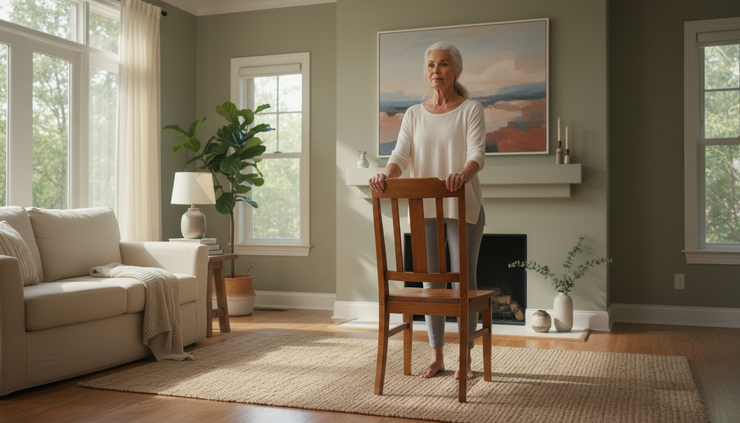
Choose a spot where you can hold on if needed. A kitchen counter, heavy dining chair, or hallway rail works well. Avoid rolling chairs, lightweight stools, and anything that can slide.
Wear shoes that stay on your feet, or go barefoot if that feels safer and you have good traction. Skip slippers that flop at the heel. Clear away throw rugs, cords, pet toys, laundry baskets, and anything else that might catch a toe.
A few small setup tips make a big difference:
Keep your phone nearby in case you need help.
Practice when you’re alert, not when you’re rushed or tired.
Stand near a wall, counter, or chair for support.
Use slow breathing. Holding your breath can make you feel unsteady.
Stop right away if you feel dizzy, short of breath, or sharp pain.
Think of support as smart training, not cheating. Holding the counter lightly lets your body practice good movement without fear taking over.
Warm up your feet, ankles, and posture
Balance starts long before you stand on one foot. Your feet, ankles, hips, eyes, and inner ear all help your body know where it is in space. A short warm-up wakes up those systems.
Do this for about 3 minutes.
March in place
Stand tall with your fingertips on the counter or chair. March slowly in place.
Lift one knee a few inches, set it down, then lift the other. Keep the movement small and controlled. Do this for 30 to 60 seconds.
If standing still feels hard, widen your feet a bit. If it feels easy, make the march a little slower. Slower is often harder because you can’t use momentum.
Roll through your feet
Stand with both feet flat. Shift your weight gently toward your toes, then back toward your heels.
Don’t lift your toes or heels very high. This is a small rocking motion. Do 10 slow rocks.
This helps your ankles get ready to make tiny corrections, which happens constantly when you walk.
Turn your head gently
Stand tall and look straight ahead. Slowly turn your head to the right, back to center, then to the left.
Do 5 turns each way.
Use support here. Looking around while standing is part of daily life, like checking for traffic or turning when someone calls your name. Practicing it gently can help.
Set your posture
Imagine a string lifting the top of your head. Let your shoulders relax. Keep your knees soft, not locked.
Good posture gives your body a better starting point. You don’t need to stand stiff. Just aim for tall, relaxed, and ready.
The daily balance routine
This is the core routine. It takes about 8 to 12 minutes. You can do it once a day, or split it into two shorter sessions.
Work near support the whole time. Use both hands, one hand, fingertips, or no hands depending on what feels safe.
1. Shift your weight side to side
Stand with feet hip-width apart. Hold the chair or counter.
Slowly shift your weight to your right foot. Don’t lift the left foot yet. Just feel more weight move into the right side. Return to center, then shift left.
Do 10 shifts each side.
Once that feels comfortable, try letting the lighter foot come just a tiny bit off the floor. Keep it low. This teaches your body how to move weight before taking a step.
2. Rise onto your toes
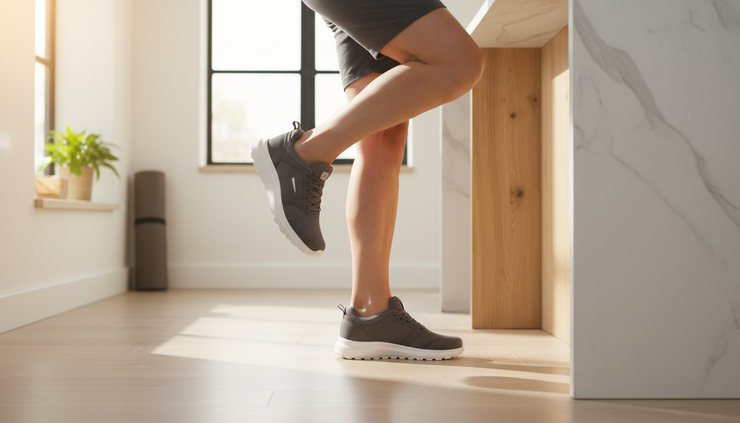
Stand tall and hold the counter. Slowly lift your heels and rise onto the balls of your feet. Pause for one second, then lower with control.
Do 8 to 12 repetitions.
This strengthens the calves and ankles, which help with walking, stairs, and recovering from small stumbles.
Make sure you lower slowly. The lowering part matters just as much as the lift.
3. Lift your toes
Keep your heels on the floor. Lift your toes and the front of your feet slightly. Lower them back down.
Do 8 to 12 repetitions.
This move works the muscles in the front of the lower leg. Those muscles help lift the toes while walking, which can lower the chance of catching a foot on the ground.
If this feels awkward, that’s normal. Keep it small.
4. Practice heel-to-toe standing
Stand beside a counter. Place one foot in front of the other, as if you’re standing on a line. The heel of the front foot should be near the toes of the back foot.
Hold for 10 to 20 seconds. Switch feet and repeat.
If heel-to-toe feels too wobbly, use a slightly wider stance. Put one foot just ahead of the other, like standing on railroad tracks instead of a tightrope.
Do 2 rounds on each side.
This builds the kind of control you need in narrow spaces, like moving through a hallway or turning in a bathroom.
5. Step back and return
Stand tall. Hold the counter. Step one foot back a short distance, then bring it back under you. Repeat with the other foot.
Do 8 steps per side.
Keep the step small. The goal is control, not distance.
Stepping backward shows up more often than people realize. You might step back to open a door, make room for someone, or move away from a cabinet. Practicing it slowly helps your body stay confident.
6. Side step along the counter
Stand facing a counter. Take two or three small steps to the right, then two or three small steps to the left.
Keep your toes pointing forward. Don’t let the feet cross.
Do this for 30 to 60 seconds.
Side stepping helps the hips, which play a big role in balance. Stronger hips can make walking and turning feel more secure.
7. Sit to stand
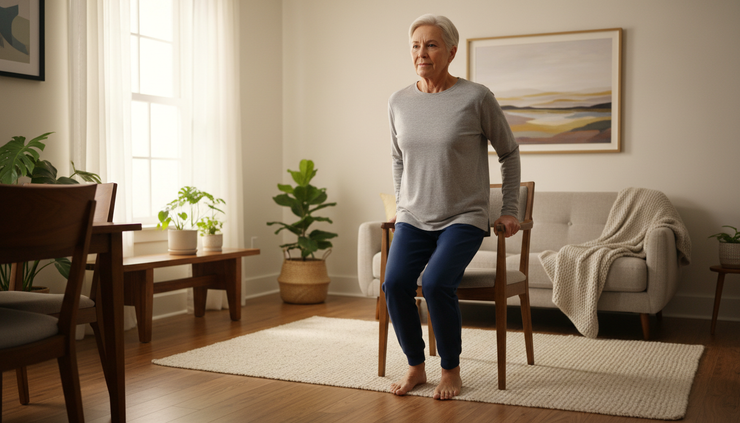
Sit near the front of a sturdy chair. Keep both feet flat on the floor. Lean forward slightly and stand up. Sit back down slowly.
Use the chair arms if needed. If you don’t need your hands, cross your arms over your chest or keep them lightly in front of you.
Do 5 to 10 repetitions.
This is one of the most useful strength moves for daily life. It supports getting up from chairs, toilets, cars, and benches.
The most important part is the slow sit. Don’t drop into the chair. Lower with control.
Make it easier or harder without guessing
A good balance routine should match the day you’re having. Some days you’ll feel steady. Some days your legs may feel tired or your focus may be off. That’s normal.
Use this simple guide.
If it feels too hard | If it feels too easy |
Hold the support with both hands | Use fingertips only |
Widen your stance | Bring your feet closer together |
Do fewer repetitions | Add one extra round |
Move slower and smaller | Add a short pause |
Practice seated warm-ups first | Try the move with less hand support |
Only change one thing at a time. If you narrow your stance, don’t also close your eyes or turn your head. Balance practice should challenge you, but it shouldn’t scare you.
A simple effort level works well. Aim for a little challenging but still controlled. If you feel like you’re grabbing for support, scale it back.
Add balance practice to normal daily life
The best routine is the one you’ll actually do. You don’t have to save every bit of balance work for exercise time. Small moments during the day count too.
Try adding one or two of these habits:
Stand tall while brushing your teeth, with one hand near the sink.
Do 5 heel raises while waiting for coffee.
Practice one sit-to-stand before lunch.
Take slow, careful turns instead of pivoting quickly.
Pause before stepping off a curb.
Look ahead while walking, not straight down at your feet.
Keep frequently used items at waist or chest height.
That last one is easy to overlook. Reaching too high or bending too low can throw off balance, especially when you’re tired. Arrange the kitchen, bathroom, and closet so everyday items are easy to reach.
Good lighting helps too. Use night-lights in hallways and bathrooms. Turn on lights before walking through a room. If you wear glasses, give your eyes a second to adjust when moving from bright to dim spaces.
Balance isn’t only about exercise. It’s also about setting up your day so your body has a fair chance.
Know when to get extra help
Daily practice can help many people feel steadier, but some signs deserve professional guidance.
Talk with a doctor, physical therapist, or qualified health professional if you notice:
New dizziness or spinning
A fall, even if you didn’t get hurt
Numbness or weakness in one leg
Sudden changes in vision
Trouble walking in a straight line
Fear of falling that keeps you from normal activities
A new medication that makes you feel lightheaded
A physical therapist can check strength, walking pattern, joint motion, footwear, and other factors that affect balance. Sometimes balance problems are linked to vision, blood pressure, inner ear issues, medication side effects, or nerve changes. Getting the right help can make practice safer and more useful.
If you’re rebuilding confidence after a fall, don’t rush. Confidence comes from repeated safe experiences. Short, consistent practice usually beats one long session once in a while.
A simple 10-minute plan to follow
Here’s the whole routine in one easy flow.
March in place for 1 minute.
Rock from toes to heels 10 times.
Turn your head gently 5 times each way.
Shift weight side to side 10 times each way.
Do 8 to 12 heel raises.
Do 8 to 12 toe lifts.
Hold heel-to-toe stance for 10 to 20 seconds each side.
Step back and return 8 times each side.
Side step along the counter for 30 to 60 seconds.
10. Do 5 to 10 sit-to-stands.
That’s it. Simple on purpose.
If you only have 5 minutes, do the warm-up, weight shifts, heel raises, side steps, and sit-to-stands. If you feel tired, do fewer reps. If you feel strong, add a second round.
The goal of The Best Daily Balance Routine for Seniors is steady progress, not perfection. You’re teaching your body to react, adjust, and trust the ground again.
If you’d like personal support building a safer fitness and wellness plan at home, you can review senior coaching options here.
FAQ
How often should seniors do balance exercises?
Daily practice works well for many people because balance improves with repetition. Keep it short and safe. Even 5 to 10 minutes can be useful when done consistently.
Should I do balance exercises if I use a cane or walker?
Yes, but use extra caution and ask a physical therapist for guidance if possible. Practice near a sturdy surface, and don’t remove support unless a professional says it’s safe.
Is it normal to feel wobbly during balance practice?
A little wobble is normal. Grabbing, stumbling, dizziness, or fear means the exercise is too hard right now. Use more support, widen your feet, or choose an easier version.
What time of day is best for balance exercises?
Pick a time when you feel alert and steady. Many people do well in the morning or early afternoon. Avoid practicing when you’re very tired, rushed, or lightheaded.
Can balance really improve with age?
Yes. Strength, posture, coordination, and reaction time can often improve with practice. Progress may be gradual, but small gains can make daily movement feel more secure.
Keep it steady and simple
Balance practice doesn’t need to be dramatic to work. A chair, a few clear feet of space, and 10 calm minutes can give your body the repetition it needs.
Start with support. Move slowly. Choose the version that feels safe today. Then come back tomorrow and do it again.
That steady habit is where confidence grows.


Comments