
The Best Daily Mobility Routine for Seniors Over 60

Getting older doesn’t mean you have to move less. In fact, a few gentle moves each day can make everything feel a little easier, getting out of a chair, reaching into a cabinet, walking to the mailbox, or turning to look over your shoulder while backing out of the driveway.
The key is consistency, not intensity. A good mobility routine should feel doable on an ordinary morning, even before coffee fully kicks in. It should wake up your joints, loosen tight spots, improve balance, and help you feel steadier on your feet.
This routine takes about 12 to 18 minutes. You don’t need fancy equipment. A sturdy chair, comfortable shoes, and a little space are enough.
This article is for general information only. If there’s a history of falls, dizziness, joint replacement, osteoporosis, heart concerns, or ongoing pain, check with a doctor or physical therapist before starting anything new.

Start with a few simple safety rules for seniors and mobility
Mobility work should feel like you’re gently oiling the hinges, not forcing a rusty door open.
Use these rules every time:
Move slowly enough that breathing stays easy.
Keep a chair, counter, or wall nearby for support.
Avoid bouncing during stretches.
Stop if there’s sharp pain, chest pain, dizziness, or unusual shortness of breath.
Work in a range that feels comfortable today, not the range you had 20 years ago.
A good guide is the “mild stretch, no sharp pain” rule. Gentle tightness is fine. Pinching, stabbing, or nerve-like pain means back off.
Also, don’t rush the first two minutes. Joints often feel stiff when starting out, especially in the morning. Give the body a chance to warm up before doing balance or standing moves.
The daily mobility routine at a glance
Here’s the full routine in order. It’s designed to move from easy seated work to standing strength and balance, then finish with light stretching.
Move | Time |
Breathing and posture reset | 1 minute |
Neck and shoulder rolls | 2 minutes |
Seated spine movement | 2 minutes |
Wrist, finger, and ankle circles | 2 minutes |
Sit-to-stand practice | 2 minutes |
Hip circles and side steps | 3 minutes |
Supported balance practice | 2 minutes |
Calf and hamstring stretching | 3 to 4 minutes |
If time is short, do the first five. If energy is good, do the full routine.
Begin with breathing and posture
Sit tall near the front of a sturdy chair. Keep both feet flat on the floor, about hip-width apart. Let the hands rest on the thighs.
Take a slow breath in through the nose. Feel the ribs expand. Breathe out through the mouth and let the shoulders soften.
Do this for about one minute.
Now gently “stack” the body:
Ears over shoulders
Shoulders over ribs
Ribs over hips
Feet flat and steady
No need to sit stiff like a soldier. Think tall but relaxed.
This first step helps the body shift from tense and guarded to ready to move. It also gives a moment to notice how everything feels before starting.
Loosen the neck and shoulders
Neck and shoulder stiffness can sneak into daily life. Reading, driving, watching TV, and using a phone can all pull the head forward. These easy moves help bring motion back without strain.
Try gentle neck turns
Sit or stand tall. Slowly turn the head to the right, only as far as comfortable. Pause for a breath. Come back to center. Turn left.
Repeat 5 times each side.
Keep the shoulders relaxed. If turning the neck feels uncomfortable, make the movement smaller. Even a little motion counts.
Add shoulder rolls
Lift both shoulders slightly toward the ears. Roll them back and down.
Repeat 8 to 10 times.
Then reverse the direction, rolling forward gently.
This can ease tension around the neck and upper back. It’s also a nice reset after sitting for a while.

Wake up the spine while seated
The spine likes movement in many directions. The goal here isn’t to twist hard or stretch as far as possible. The goal is to remind the back that it can move.
Do a seated cat-cow
Sit near the front of the chair with hands resting on the thighs.
On an inhale, gently lift the chest and look slightly forward. Let the back arch a little.
On an exhale, round the upper back slightly and look toward the lap.
Repeat 6 to 8 times.
Move at the speed of your breath. Keep it smooth.
Try seated side bends
Sit tall. Place the right hand on the chair or thigh. Reach the left arm gently upward, then lean a little to the right. Come back to center.
Switch sides.
Repeat 3 to 5 times each side.
This helps loosen the ribs, waist, and upper back. It can also make reaching overhead feel easier.
Give the hands, wrists, ankles, and feet some attention
Small joints matter. Hands help with grip, cooking, dressing, and opening jars. Ankles and feet help with walking, balance, and stepping over curbs.
Open and close the hands
Hold the arms comfortably in front of the body or rest the forearms on the thighs.
Spread the fingers wide. Then make a gentle fist.
Repeat 10 times.
Now circle the wrists slowly 5 times each direction.
Circle the ankles
While seated, extend one foot slightly forward. Circle the ankle one way 5 times, then the other way 5 times.
Switch feet.
Try to move through the biggest comfortable circle. If the ankle feels stiff, keep it small and easy.
Add heel and toe lifts
Keep both feet on the floor. Lift the heels while the toes stay down. Lower them. Then lift the toes while the heels stay down.
Repeat 10 times.
This supports ankle mobility and helps wake up the lower legs before standing.
Practice getting out of a chair
The ability to stand up from a chair is one of the most useful strength and mobility skills. It supports independence in a very practical way.
Sit near the front of a sturdy chair. Place both feet flat on the floor, hip-width apart. Cross the arms over the chest, or use the chair arms if needed.
Lean the chest slightly forward. Press through the feet and stand up tall. Sit back down slowly.
Do 5 to 8 repetitions.
If that feels too hard, use the hands for help. If it feels easy, slow down the lowering part. The slow sit is where a lot of useful strength gets built.
Keep the knees pointing in the same direction as the toes. Try not to let them collapse inward.
This is one of the best moves in The Best Daily Mobility Routine for Seniors Over 60 because it connects strength, balance, hip motion, ankle movement, and confidence all at once.
Open the hips and step side to side
The hips can get tight from too much sitting. Gentle standing movements help with walking, climbing stairs, and turning.
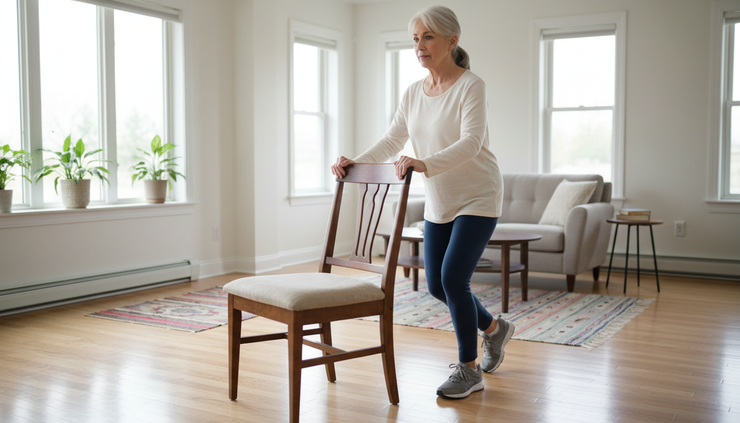
Stand behind a sturdy chair and hold the back of it with both hands.
Make small hip circles
Shift weight gently and draw a small circle with the hips. Imagine stirring a pot with the pelvis.
Circle 5 times one way, then 5 times the other way.
Keep the knees soft. Don’t force a big circle.
Step side to side
Still holding the chair if needed, step the right foot out to the side. Bring it back in. Step the left foot out. Bring it back in.
Repeat 8 to 10 times each side.
Stand tall and keep the toes pointing forward. If balance feels shaky, make the steps smaller.
Add a little balance practice
Balance can improve with practice, but it should be done safely. Always use support nearby.
Stand behind the chair and hold it with both hands. Shift weight gently from one foot to the other.
Now try this:
Lift the right heel so only the toes touch.
If steady, lift the right foot slightly off the floor.
Hold for 5 to 10 seconds.
Set the foot down.
Repeat on the left side.
Do 2 rounds each side.
If that’s too easy, use one hand on the chair instead of two. If that’s still easy, hover the fingers above the chair but keep them close.
The goal is not to prove anything. The goal is to build steadiness in a safe way.
Finish with easy calf and hamstring stretches
A short cool down helps the body settle. These stretches can be helpful if the back of the legs feels tight during walking.
Stretch the calves
Stand facing a wall or the back of a chair. Step the right foot back. Keep the right heel down and the right knee mostly straight. Bend the front knee slightly.
Hold 20 to 30 seconds. Switch sides.
You should feel a gentle stretch in the back of the lower leg.
Stretch the hamstrings
Sit near the front of the chair. Extend the right leg forward with the heel on the floor and toes pointing up. Keep the back long and hinge slightly forward from the hips.
Hold 20 to 30 seconds. Switch sides.
Don’t round the back or force the stretch. A mild pull behind the thigh is enough.
Make the routine fit real life
A routine only works if it fits the day. Some mornings will feel great. Others won’t. That’s normal.
Try this simple plan:
If you have | Do this |
5 minutes | Breathing, shoulders, ankles, sit-to-stands |
10 minutes | Add spine moves, hip circles, and side steps |
15 minutes or more | Do the full routine with balance and stretching |
It may help to pair the routine with something already part of the day. Do it after brushing teeth, before breakfast, after a morning walk, or during a favorite TV show.
Keep the bar low at first. Five consistent minutes beat one long session that only happens once.

How to know it’s helping
Daily mobility work usually pays off in small ways before big ones.
Look for signs like these:
Getting out of a chair feels smoother.
Morning stiffness fades a little faster.
Walking feels more natural.
Turning, reaching, or bending feels less awkward.
Balance feels steadier during everyday tasks.
Progress doesn’t have to mean doing harder exercises. Sometimes progress means the same routine feels easier, calmer, and more comfortable.
If there’s pain that lingers after the routine, swelling, new weakness, or a sudden change in balance, pause and get medical guidance.
For extra support with exercise planning, healthy aging, and staying consistent, you can explore senior coaching plans here.
Frequently asked questions
Should this routine be done every day?
Yes, if it feels good. Keep it gentle. Mobility work is usually easier to do daily than harder strength workouts. If the body feels sore or tired, do a shorter version.
Is it better to do mobility exercises in the morning or evening?
Either works. Morning mobility can reduce stiffness and help the day start smoothly. Evening mobility can ease tension from sitting. Pick the time that’s easiest to repeat.
What if balance feels poor?
Use a chair, wall, or counter the whole time. Skip unsupported balance moves until a doctor or physical therapist says they’re safe. Safety matters more than difficulty.
How long before results show up?
Some people feel looser right away. Bigger changes in balance, strength, and confidence usually take regular practice over time. A few minutes most days can add up.
Can this routine replace walking?
No. Walking is still great for heart health, endurance, mood, and overall fitness. This routine pairs well with walking because it helps the joints and muscles move more comfortably.
A simple routine can change the whole day
The best daily mobility routine is the one that actually gets done. Keep it gentle, use support when needed, and let the body warm up at its own pace.
Start with 5 minutes tomorrow. If that feels good, add a little more. Over time, those small daily movements can make ordinary life feel easier, steadier, and more comfortable.


Comments