
Turn Your Daily Walk Into a Gentle Strength Building Workout for Seniors

A daily strength walk for seniors is already one of the best habits you can keep. It gets you outside, loosens stiff joints, helps your balance, and gives your mood a lift. But with a few small changes, that same walk can also help you build strength safely, without turning it into a hard gym session.
The key is to keep it gentle, steady, and realistic. You don’t need heavy weights. You don’t need to walk fast the whole time. You just need to add short strength moments along the way, using your body weight, good posture, and simple movements.
This guide is for turning a regular stroll into something a little more useful for your legs, hips, core, arms, and balance. Go slowly, listen to your body, and check with your doctor or physical therapist if you have heart issues, joint pain, dizziness, recent surgery, or any condition that affects exercise.

Start with a walk that feels easy for seniors to build strength
Before adding strength work, make sure the walk itself feels comfortable.
A good starting point is a route you already know. Choose a place with even ground, good lighting, and places to rest if you need them. A loop around the block, a paved park path, a quiet mall, or a hallway in your building can all work.
For the first 5 minutes, walk at an easy pace. Let your body warm up. Your breathing should feel natural. You should be able to talk in short sentences without gasping.
During this warm-up, check a few basics:
Keep your eyes forward, not down at your feet.
Let your shoulders relax.
Stand tall, as if a string is gently lifting the top of your head.
Swing your arms naturally.
Take shorter steps if your knees, hips, or back feel stiff.
This is also the time to notice how you feel that day. Some days are strong days. Some days are “let’s keep it simple” days. Both count.
A gentle strength walk should leave you feeling pleasantly used, not worn out.
Add better posture before you add harder moves
Posture is strength work, even if it doesn’t look dramatic.
When you walk tall, your core muscles have to help support you. Your hips and back work better. Your balance improves because your body is stacked in a steadier position.
Try this simple posture check during your walk:
Stand tall
Imagine your chest opening slightly, without puffing it out.
Pull your belly in gently
Don’t hold your breath. Just lightly tighten your lower belly, as if you’re zipping up a snug pair of pants.
Relax your shoulders
Lift them toward your ears, then let them drop. Keep that softer feeling as you walk.
Step heel to toe
Let your heel land first, then roll through the foot and push off gently with your toes.
That tiny push-off helps wake up the calves and feet. Those muscles matter more than many people realize. Strong feet and calves support balance, walking speed, and confidence on curbs or uneven sidewalks.
Try holding this taller walking posture for 30 seconds at a time. Then relax. Repeat a few times during your walk.
Use short strength intervals
You don’t need to make the whole walk harder. Short intervals work better for most people, especially if you’re building up slowly.
Think of your walk in small sections. Walk normally for a few minutes, then add 30 to 60 seconds of a strength-focused move. Then go back to easy walking.
Here’s a simple pattern:
Part of the walk | What to do |
First 5 minutes | Easy warm-up walk |
Middle 10 to 20 minutes | Add short strength intervals |
Last 5 minutes | Slow down and cool off |
This turns your daily walk into a strength-building workout without making it feel like a chore.
Start with just 2 or 3 strength intervals. If that feels good for a week or two, add one more. Small progress is still progress.
Try gentle moves that build walking strength
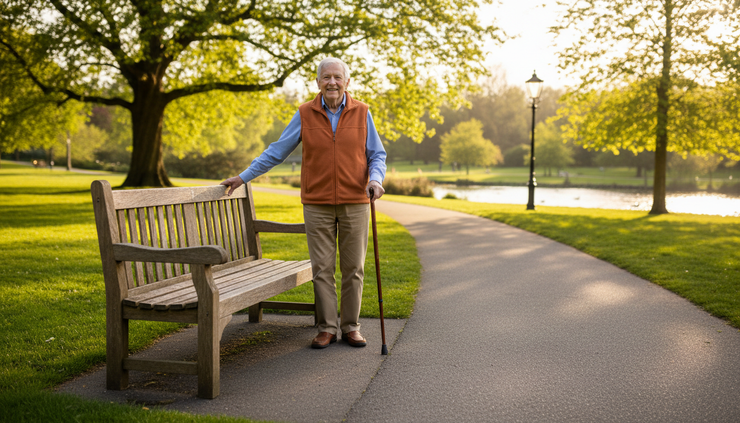
These moves are simple and can be done during a walk. Use a bench, wall, railing, or sturdy fence for support when needed. If anything causes sharp pain, stop.
Do bench sit to stands
This is one of the best walking strength exercises because it trains your thighs, hips, and glutes. Those muscles help you climb stairs, get out of chairs, and stay steady.
Find a stable bench. Sit down with your feet flat and about hip-width apart.
Then:
Lean forward slightly from the hips.
Press through your heels.
Stand up tall.
Sit back down slowly.
Try 5 sit to stands. Rest. If that feels easy, do 2 rounds.
Keep your knees pointing in the same direction as your toes. If the bench is very low or your knees don’t like it, skip this one or use a higher seat at home instead.
Add slow heel raises
Heel raises strengthen the calves and ankles. They also help with balance and push-off when walking.
Stand near a bench, wall, or railing. Hold on lightly.
Then:
Lift both heels off the ground.
Pause for 1 second.
Lower slowly.
Try 8 to 10 heel raises.
Go slow. The lowering part matters. That’s where your muscles learn control.
Practice side steps
Walking mostly moves you forward. Side steps train the hip muscles that help keep you steady when you turn, step around something, or catch your balance.
Find a flat, open stretch of path.
Then:
Face forward.
Step to the right with your right foot.
Bring your left foot in to meet it.
Take 5 steps to one side.
Take 5 steps back the other way.
Keep your toes pointing forward. Don’t let your feet cross.
If this feels wobbly, do it along a wall or railing.
Do gentle marching
Marching helps your hip flexors, thighs, and core. It can also improve foot clearance, which matters if you sometimes shuffle or catch your toes.
Stand tall and hold a support if needed.
Then:
Lift one knee a few inches.
Set it down slowly.
Lift the other knee.
Keep alternating.
Try 10 slow marches total.
Don’t worry about lifting high. Controlled movement matters more than height.
Try wall push-ups
Your walk can strengthen your upper body too. Wall push-ups are easier on the wrists and shoulders than floor push-ups.
Find a sturdy wall or smooth fence. Place your hands on it at chest height.
Then:
Step your feet back a little.
Bend your elbows and bring your chest toward the wall.
Press back to the starting position.
Try 5 to 10 repetitions.
Keep your body long, like a plank. If it feels too hard, stand closer to the wall.

Make your walk work your arms and core
You can add strength without stopping at all. Just change how you move for short stretches.
Try 30 seconds of stronger arm swings. Bend your elbows around 90 degrees and swing from the shoulders. Keep the movement smooth, not jerky. This warms up the arms and encourages a better walking rhythm.
You can also try a “tall belly” interval. For 30 seconds, walk with your belly gently tightened and your posture tall. Breathe the whole time. This teaches your core to support you while moving.
If you already use walking poles, they can help bring the upper body into the walk. Plant each pole lightly and push back as you step. Keep the grip relaxed, and don’t lean heavily on the poles unless they were recommended for support.
Skip hand weights unless a professional has told you to use them. They can strain the shoulders, elbows, or wrists, especially if you swing them quickly. A better choice is body weight strength during pauses.
Use effort, not speed, to guide yourself
A strength walk doesn’t need to be fast. In fact, going too fast can make form sloppy.
Use a simple effort scale from 1 to 10:
1 to 2 feels very easy.
3 to 4 feels comfortable.
5 to 6 feels like work, but you can still talk.
7 or higher feels hard.
For most gentle strength walks, aim for a 3 to 5. During a short interval, you might reach a 6. Then bring it back down.
Watch for signs that you should pause or stop:
Chest pain or pressure
Dizziness
Unusual shortness of breath
New or sharp joint pain
Feeling faint
Sudden weakness
Pain that changes your walking pattern
If you feel any of these, stop and get help if needed. This article is for general information and isn’t a substitute for medical advice.
Build a simple weekly routine
You don’t have to do strength moves every day. Your body gets stronger when it has time to recover.
Here’s an easy weekly plan:
Day | Walk idea |
Monday | Easy walk with 2 or 3 strength intervals |
Tuesday | Regular relaxed walk |
Wednesday | Easy walk with posture and arm swing practice |
Thursday | Rest or short casual walk |
Friday | Walk with 3 or 4 strength intervals |
Saturday | Regular walk at a comfortable pace |
Sunday | Rest, stretch, or take a gentle stroll |
If that feels like too much, cut it in half. If it feels too easy, add one interval at a time.
A good goal is to finish the walk feeling like you could do a little more. That’s how you build consistency.
Keep it safe and comfortable
A few small choices can make these walks much more enjoyable.
Wear supportive shoes with good traction. Bring water if the weather is warm or your walk is longer than usual. Carry a phone if you walk alone. In hot weather, go earlier or later in the day. In cold weather, give yourself more warm-up time.
Choose strength stops carefully. A bench should feel sturdy. A wall should be flat and dry. Avoid doing exercises near traffic, loose gravel, wet leaves, ice, or uneven curbs.
If balance is a concern, keep one hand near support. There’s no prize for doing any move unsupported. Safe practice builds confidence.
It also helps to track what you did. Nothing fancy needed. Write down:
How long you walked
Which strength moves you tried
How you felt afterward
Any pain, stiffness, or fatigue later in the day
Patterns show up quickly. Maybe heel raises feel great, but sit to stands need fewer repetitions. Maybe morning walks feel better than evening walks. Use that information.

A sample 25 minute gentle strength walk
Here’s a simple routine you can try. Adjust the time and repetitions as needed.
Minutes 1 to 5
Walk easily. Let your body warm up.
Minutes 6 to 8
Walk tall with relaxed shoulders. Add a little more arm swing.
Minute 9
Stop at a bench or wall. Do 5 sit to stands or 8 heel raises.
Minutes 10 to 13
Walk at a comfortable pace.
Minute 14
Do 5 slow side steps each direction.
Minutes 15 to 18
Walk normally. Focus on heel-to-toe steps.
Minute 19
Do 5 to 10 wall push-ups.
Minutes 20 to 22
Walk slowly and stand tall.
Minute 23
Do 10 gentle marches, holding support if needed.
Minutes 24 to 25
Cool down with easy walking.
That’s it. Nothing extreme. Just enough to ask your muscles to help out a little more.
If you’d like support building a walking and wellness routine that fits your life, you can explore My Senior Coach pricing plans and see what kind of guidance feels right for you.
FAQ
How often should I add strength moves to my walk?
Start with 2 days a week. If you feel good and recover well, try 3 days a week. Keep at least one easier day between strength walks.
What if I already have knee or hip pain?
Keep the movements small and gentle. Avoid anything that causes sharp pain. A physical therapist can help you choose safer versions of exercises.
Do I need ankle weights or hand weights?
No. Most people can build useful strength with body weight, posture, slow movements, and support from a bench or wall. Weights can add strain if they’re not used carefully.
How long should the walk be?
Even 10 to 15 minutes can help. A 20 to 30 minute walk gives you more room for warm-up, strength intervals, and cool-down, but shorter walks still count.
How will I know I’m getting stronger?
Daily tasks may feel easier. You may stand from a chair with less effort, feel steadier on curbs, or walk a little longer without tiring. Those are real wins.
Keep the walk gentle, but make it count
Your daily walk doesn’t need a complete makeover. Just add small moments of strength. Stand a little taller. Push through your feet. Pause for heel raises. Use a bench for sit to stands. Practice side steps. Cool down slowly.
The best routine is the one you’ll actually keep doing. Start small, repeat it often, and let your walk become a quiet way to build strength, balance, and confidence.


Comments