
Why Grip Strength Matters for Seniors and How to Improve It

A firm handshake can tell you more than you might think.
Grip strength isn’t just about opening pickle jars or carrying grocery bags. For older adults, it’s one of the simplest clues we have about overall strength, independence, and even long-term health. Researchers often use grip strength because it’s easy to measure, low-cost, and closely tied to how the whole body is doing.
That doesn’t mean a weak grip “causes” health problems. It means grip strength can act like a warning light on the dashboard. If it starts to fade, it may be time to pay attention to muscle, balance, nutrition, activity level, and daily function.
The good news is that grip strength can often improve with simple, safe practice. You don’t need a gym. You don’t need heavy weights. You just need the right moves, a little consistency, and a plan that respects your joints.

Grip strength is a window into whole-body health
Grip strength matters because your hands don’t work alone. To squeeze, hold, twist, or carry, your body uses muscles in the fingers, wrists, forearms, shoulders, back, and core. Your nervous system also has to send clear signals, and your joints need enough mobility to move without pain.
That’s why a simple squeeze test can reflect more than hand strength.
Low grip strength may be linked with:
Lower overall muscle mass
Reduced physical activity
Higher fall risk
Slower walking speed
More trouble with daily tasks
Frailty or early loss of independence
Think of grip as a quick check of your “functional reserve.” That means how much strength you have in the tank for everyday life.
Carrying laundry, pushing up from a chair, opening heavy doors, holding a railing, and lifting a pot from the stove all ask for grip in some way. When grip weakens, people often start avoiding tasks without even noticing it. That can lead to less movement, which leads to more weakness.
That cycle is worth breaking early.
Grip strength is useful because it’s practical. If your hands are stronger, daily life usually feels easier.
Why grip strength and longevity are connected
Studies have found that weaker grip strength is associated with higher risk of poor health outcomes in older adults. That includes disability, hospital stays, and earlier death. Again, grip strength isn’t destiny. It’s a marker.
So why does it seem to predict longevity?
Because aging well depends on more than one body system. Grip strength can reflect several of them at once.
Muscle keeps you resilient
After midlife, adults tend to lose muscle unless they actively work to keep it. This age-related muscle loss can affect balance, walking, posture, and the ability to recover after illness or injury.
Hands and forearms are small compared with the legs or hips, but grip strength often tracks with total body strength. A weak grip may suggest that larger muscles need attention too.
Stronger hands support safer movement
Grip helps with fall prevention in practical ways. You need it to hold railings, use a cane or walker, steady yourself on a countertop, or catch your balance when you stumble.
A stronger grip won’t prevent every fall, but it gives you more options in the moment.
Daily tasks protect independence
Longevity isn’t only about years. It’s also about the quality of those years. A stronger grip helps with the ordinary tasks that keep life flexible:
Carrying groceries from the car
Buttoning clothes
Opening containers
Gardening
Cooking
Holding a grandchild’s hand
Gripping exercise equipment safely
These things may sound small, but they add up. Independence often depends on many small strengths working together.
How to check your grip strength at home
Clinics often use a hand dynamometer, a small device that measures grip force. If you’ve ever had a physical therapy evaluation, you may have used one.
At home, you can use simpler checks. They won’t give you a perfect number, but they can show changes over time.
Try one or two of these every few weeks.
The jar test
Pick a jar with a screw lid, ideally one you use often. Notice whether it feels easy, difficult, or impossible to open.
Don’t strain hard. The point is to track function, not prove anything.
The grocery carry test
Use a light reusable bag with a few items inside. Carry it for 30 seconds in one hand, then switch hands.
Pay attention to:
Whether one side feels much weaker
Whether your wrist hurts
Whether your shoulder hikes up
Whether you feel unsteady
The towel wring test
Wet a small towel and wring it out over the sink. Notice how much force you can use without pain.
This test checks grip, wrist rotation, and coordination.
The chair push support check
Sit in a sturdy chair with arms. Place your hands on the armrests and gently help yourself stand.
If your hands, wrists, or shoulders feel weak or painful during this, it may be a sign to build upper-body strength carefully.
Stop any test that causes sharp pain, numbness, chest discomfort, dizziness, or shortness of breath. This article is for general information and isn’t a substitute for medical advice. If you have arthritis, recent injury, nerve symptoms, osteoporosis, heart concerns, or uncontrolled blood pressure, ask your doctor or physical therapist before starting new exercises.
The best grip exercises for seniors
You can train grip two to four days per week. Start easy. Your hands have small joints and tendons that don’t like sudden jumps in workload.
A little tired feeling is fine. Pain is not.
Use this simple rule: after an exercise, your hands should feel normal again within a few hours. If they ache the next day, do less next time.
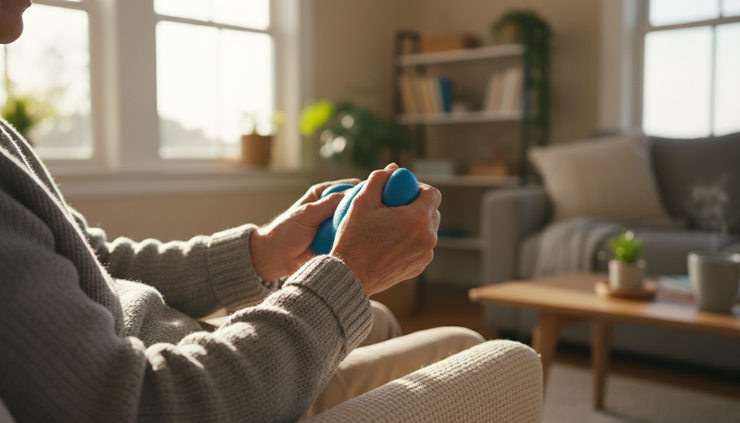
Squeeze a soft ball
This is the classic starting point for a reason. It’s simple, gentle, and easy to control.
How to do it:
Hold a soft therapy ball, foam ball, or rolled pair of socks.
Squeeze slowly for 2 to 3 seconds.
Relax fully.
Repeat 8 to 12 times.
Switch hands.
Start with 1 set. Build to 2 or 3 sets as it gets easier.
Keep your shoulders relaxed. Don’t clench your jaw. The goal is controlled strength, not maximum effort.
Practice finger extensions
Grip training shouldn’t only be squeezing. The muscles that open the hand matter too, especially if your fingers feel stiff.
How to do it:
Place a rubber band around your fingers and thumb.
Open your hand gently against the band.
Pause for 1 second.
Relax.
Repeat 8 to 12 times.
Use a light band. If a rubber band bothers your skin, open your hand wide without resistance instead.
This move can help balance all the squeezing work.
Carry light weights
Carrying is one of the most useful grip exercises because it looks like real life.
How to do it:
Hold a light dumbbell, water bottle, or grocery bag in one hand.
Stand tall near a counter or sturdy surface.
Hold for 10 to 20 seconds.
Switch hands.
If you feel steady, walk slowly across the room and back. Keep the weight light at first.
This is often called a farmer carry, but you don’t need heavy equipment. A soup can works.
Wring a towel
This builds grip and wrist strength together.
How to do it:
Hold a dry hand towel with both hands.
Twist it as if you’re wringing out water.
Twist the other direction.
Repeat 5 to 10 times each way.
Start dry. A wet towel adds more resistance and may be too much at first.
Pinch a towel or paper plate
Pinch strength helps with keys, buttons, cards, and small kitchen tools.
How to do it:
Hold a folded towel, paper plate, or thin book between your thumb and fingers.
Pinch gently.
Hold for 5 to 10 seconds.
Rest.
Repeat 5 to 8 times.
Avoid this one if it flares thumb arthritis. If your thumb joint aches, choose the soft ball exercise instead.

Build grip strength without irritating your joints
Hands can be sensitive. If you have arthritis, carpal tunnel symptoms, trigger finger, or old wrist injuries, gentle progress matters more than intensity.
Here’s how to make grip training safer.
Warm your hands first
Before exercising, move your fingers slowly. Open and close your hands 10 times. Circle your wrists. Rub your palms together.
Some people like using a warm towel for a few minutes before hand exercises. Warmth can reduce stiffness and make movement feel easier.
Use effort you can control
Don’t squeeze as hard as possible every time. Max-effort gripping can irritate tendons and joints.
Aim for about a 5 or 6 out of 10 effort. You should feel like you’re working, but still in control.
Train both hands
It’s normal for one hand to be stronger, usually the dominant one. Still, train both sides.
If one hand is suddenly much weaker, or if weakness comes with numbness, facial drooping, confusion, or trouble speaking, seek medical help right away. Sudden one-sided weakness can be serious.
Give your hands rest days
Muscles get stronger during recovery. Tendons need recovery too.
A simple schedule might look like this:
Monday
Grip exercises
Tuesday
Rest or gentle hand movement
Wednesday
Grip exercises
Thursday
Rest
Friday
Grip exercises
Weekend
Daily activities, walking, stretching
You can still use your hands normally on rest days. Just skip the extra squeezing.
Don’t stop at the hands
Grip strength matters, but it works best as part of a bigger strength plan.
If you only train your hands, you’ll miss the larger muscles that help you stand, walk, climb stairs, and stay steady. Strong legs, hips, back, and core make grip more useful.
Pair hand exercises with simple full-body moves such as:
Sit-to-stands from a sturdy chair
Wall push-ups
Heel raises while holding a counter
Step-ups on a low step
Gentle rows with a resistance band
Walking at a comfortable pace
These exercises support the same goal: staying capable in daily life.
Protein, sleep, and hydration matter too. Muscles need building blocks. If appetite has changed, weight has dropped without trying, or meals feel harder to manage, it’s smart to bring that up with a healthcare professional.
A simple 10-minute grip routine
Here’s an easy routine you can try two or three times per week. Keep it gentle the first week.
Warm up for 2 minutes
Open and close your hands slowly. Circle your wrists. Shake out your fingers.
Do soft ball squeezes for 2 minutes
Do 8 to 12 slow squeezes per hand. Rest. Repeat once if it feels good.
Do finger extensions for 2 minutes
Use a light rubber band or no band. Open the hand slowly, then relax.
Do light carries for 2 minutes
Hold a water bottle or light bag for 10 to 20 seconds per hand. Stay near a counter if balance is a concern.
Cool down for 2 minutes
Stretch your fingers gently. Massage the palm and forearm. Take slow breaths.
The goal isn’t to crush anything. The goal is to make your hands more reliable for everyday life.
How to know it’s working
Progress may be subtle at first. That’s normal.
Look for small wins like these:
Jars feel easier to open
Grocery bags feel more secure
Hands feel less tired after cooking
You feel steadier holding a railing
Your weaker hand feels more useful
You can do more repetitions without strain
Try not to test yourself every day. Check once every two to four weeks. Daily testing can make progress feel slower than it is.
If you want help building a full plan that fits your health, strength level, and schedule, take a look at My Senior Coach pricing plans. A little guidance can make exercise feel less confusing and more doable.
Frequently asked questions
How often should seniors train grip strength?
Two to four times per week works well for many people. Start with two days if your hands get sore easily. Add more only if your joints feel good.
Can grip exercises help arthritis?
Gentle hand exercises may help some people maintain movement and function, but arthritis varies a lot. Avoid painful squeezing, especially during a flare. Ask a doctor, occupational therapist, or physical therapist for exercises that fit your hands.
Is a stronger grip enough to prevent falls?
No single exercise can prevent falls. Grip helps because it supports railings, canes, walkers, and balance reactions. For fall prevention, combine grip work with leg strength, balance practice, vision checks, safe footwear, and a safer home setup.
What if one hand is much weaker than the other?
A small difference is common. A sudden change is not. If one hand becomes weak quickly, especially with numbness, confusion, face drooping, or speech trouble, get emergency medical help.
Do I need special grip tools?
No. A soft ball, towel, rubber band, water bottle, or grocery bag can work well. Fancy tools are optional. Comfort and consistency matter more.
The takeaway
Grip strength is a small measurement with a big message. It reflects muscle, movement, independence, and the ability to handle daily life with confidence.
Start simple. Squeeze a soft ball. Carry a light bag. Open your hands against gentle resistance. Pair that with leg and balance work, and give your body time to respond.
Stronger hands won’t solve everything, but they can make life feel easier in dozens of quiet ways. And that’s a very good reason to train them.


Comments