
Chair Strength Training for Seniors A Simple Full Body Workout Anytime

Some days, getting to the gym is too much. Some days, the weather doesn’t cooperate. And some days, the best workout is the one you can do right where you are, with a sturdy chair and a little space to move.
Chair strength training is a practical way to work your legs, arms, back, shoulders, and core without getting down on the floor. It can help you practice everyday movements like standing up, reaching into a cabinet, carrying groceries, and walking with more confidence.
This workout is gentle enough to start small, but it can still be challenging in the right way. You’ll use slow movements, good posture, and light resistance from your own body, a towel, or small hand weights if you have them.
A quick safety note before we start: this post is for general information, not medical advice. If you have heart concerns, balance issues, recent surgery, pain that’s new or sharp, or a condition that affects exercise, check with your health care provider before trying a new routine.
Why chair strength training for seniors works
A chair doesn’t make exercise “less real.” It gives your body support so you can focus on the movement.
That matters because strength is built through repeated, controlled effort. You don’t have to lift heavy weights to get benefits. You can build useful strength by learning to move with control, adding repetitions over time, and choosing exercises that match daily life.
Think about how often these movements show up during the day:
Standing up from a chair
Lifting a laundry basket
Reaching for a plate
Stepping into the shower
Climbing a curb
Picking something up from a table
Holding your posture while walking
A good chair workout trains those same patterns in a safer, more supported way.
The goal isn’t to feel wiped out. The goal is to feel warm, awake, and steady when you finish. A little muscle fatigue is okay. Pain, dizziness, chest pressure, or shortness of breath that feels unusual is not. Stop right away if something feels off.
Set up your chair and space
Before you begin, take one minute to set yourself up well. It makes the whole workout smoother.
Choose a chair that:
Doesn’t roll
Doesn’t wobble
Has a firm seat
Lets your feet touch the floor
Is positioned on a non-slip surface
An armless dining chair often works well. If you need more support, use a chair with arms for sit-to-stand practice or keep it near a wall.
Wear shoes that grip the floor. Keep water nearby. If you use a resistance band, light hand weights, or soup cans, place them within easy reach so you don’t have to twist or rush.
Use a simple effort scale from 1 to 10. A 1 feels like almost nothing. A 10 feels like your hardest effort. For this routine, aim for about 4 to 6 out of 10. You should be able to talk in short sentences.
Warm up with easy movement
Don’t skip the warm-up. It tells your joints and muscles, “We’re about to move.”
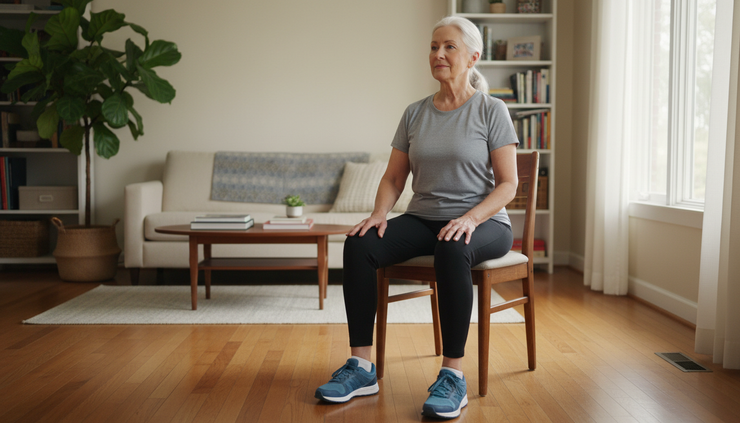
Sit tall near the front half of the chair. Keep both feet flat on the floor, about hip-width apart. Let your shoulders relax.
Do each warm-up move for about 30 seconds.
March your feet
Lift one foot, set it down, then lift the other. Keep the movement small at first.
If your hips feel stiff, make the march slower. If it feels good, lift your knees a little higher.
Roll your shoulders
Roll your shoulders up, back, and down. Then switch directions.
Try not to shrug near your ears. Keep your neck long.
Open and close your hands
Make gentle fists, then spread your fingers wide. This warms up your hands and forearms.
This is especially nice before using weights, cans, or a towel.
Reach across your body
Reach one hand toward the opposite knee, then switch sides. Keep your chest lifted.
This wakes up your upper back and core without asking for a big twist.

Do this full-body chair strength workout
Move slowly. Rest when you need to. If one round feels like plenty, stop there. If you feel good, do a second round.
A nice starting point is:
Exercise | Repetitions | Main area worked |
Sit-to-stand | 6 to 10 | Legs and hips |
Seated knee extensions | 8 to 12 each side | Thighs |
Heel and toe raises | 10 to 15 | Calves and shins |
Towel row | 8 to 12 | Back and arms |
Seated chest press | 8 to 12 | Chest and shoulders |
Seated overhead reach | 6 to 10 | Shoulders and upper back |
Core brace with knee lift | 6 to 10 each side | Core and hips |
Seated side steps | 8 to 12 each side | Hips and legs |
Rest for 30 to 60 seconds between exercises if you need it.
Sit-to-stand
This is one of the most useful strength moves you can do.
Sit near the front of the chair with feet flat on the floor. Cross your arms over your chest or place your hands lightly on the chair arms if you need support. Lean forward slightly from your hips, press through your feet, and stand up.
Pause for a second. Slowly sit back down.
Keep your knees pointing in the same direction as your toes. Try not to drop into the chair. The slow lowering part builds strength, too.
Make it easier by using your hands. Make it harder by standing up without using your arms.
Seated knee extensions
Sit tall with both feet flat. Straighten one knee and lift your foot until the leg is nearly straight. Hold for one second, then lower with control.
Switch sides.
You should feel this in the front of your thigh. If your knee feels uncomfortable, don’t kick as high. Smaller is fine.
Heel and toe raises
Keep both feet on the floor.
Lift your heels while keeping your toes down. Lower them slowly. Then lift your toes while keeping your heels down.
This move helps the muscles around your lower legs and ankles. Those muscles matter for walking, balance, and stepping over small obstacles.
Towel row
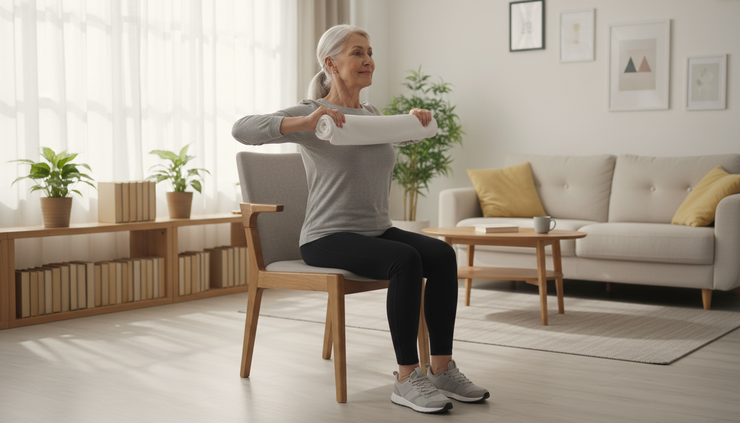
Hold a small towel with both hands in front of your chest. Pull gently outward on the towel so your arms feel active.
Now pull your elbows back as if you’re rowing a boat. Squeeze your shoulder blades together, then return your arms forward.
Keep your shoulders down, not hunched.
This is a great move if you spend a lot of time sitting, reading, or looking down at a phone or tablet. It reminds the upper back to help hold you upright.
Seated chest press
Hold a towel, light weights, or two soup cans at chest level. Press your hands forward until your arms are almost straight. Bring them back toward your chest with control.
Keep your wrists straight. Keep your back tall against your own posture, not slumped into the chair.
This works your chest, shoulders, and arms. It also trains the reaching motion you use when pushing open a door or placing something on a shelf.
Seated overhead reach
Start with hands near your shoulders. Reach both arms up as far as comfortable, then lower them slowly.
If your shoulders are sensitive, reach forward and slightly up instead of straight overhead. You can also do one arm at a time.
Don’t hold your breath. Exhale as you reach. Inhale as you lower.
Core brace with knee lift
Sit tall near the front of the chair. Place your hands on the sides of the seat or on your thighs.
Gently tighten your belly as if you’re preparing for a cough. Lift one knee a few inches, then lower it. Switch sides.
The goal is not to lean back or round your spine. Keep the lift small and controlled.
This trains your core to support your body while your legs move. That’s useful for walking, stairs, and getting in and out of a car.
Seated side steps
Sit tall. Step your right foot out to the side, then bring it back to center. Repeat on the left.
Keep your toes facing forward. Try not to let your knees collapse inward.
This move works the outer hips, which help with side-to-side control. That can support steadier walking and easier turning.
Make the workout fit your day
One of the best parts of Chair Strength Training for Seniors A Simple Full Body Workout Anytime is that it doesn’t need a perfect schedule. You can do the full routine, or you can break it into small pieces.
Try one of these simple plans.
If you have this much time | Do this |
5 minutes | Warm up, sit-to-stand, towel row, heel raises |
10 minutes | Warm up and one round of the workout |
20 minutes | Warm up, two rounds, and cool down |
Low-energy day | Warm up, slow marches, gentle reaches |
Strong day | Add a second set or light weights |
Two or three days a week is a good place to start for strength work. Leave a rest day between harder sessions when you can. On other days, a short walk or gentle stretching can pair nicely with the routine.
The key is consistency. A few minutes done often beats a long workout you rarely feel like doing.
Cool down before you move on
A cool down helps your body settle. It only needs a few minutes.
Take slow breaths
Sit tall. Inhale through your nose if that feels comfortable. Exhale slowly through your mouth.
Let your shoulders drop.
Stretch your calves
Sit near the front of the chair. Straighten one leg and place the heel on the floor with toes pointing up. Lean forward slightly from your hips until you feel a gentle stretch in the back of the lower leg.
Hold for 15 to 30 seconds, then switch sides.
Stretch your chest
Place your hands behind your back or hold the sides of the chair. Gently lift your chest. Keep your chin level.
This should feel open, not forced.
Relax your hands
Open and close your fingers a few times. Shake out your hands gently.
Small muscles worked too, especially if you used a towel or weights.

How to adjust if something feels too easy or too hard
Your workout should meet you where you are today. That may change from week to week, or even from morning to afternoon.
If it feels too hard:
Do fewer repetitions
Move more slowly
Use a chair with arms
Keep your range of motion smaller
Rest longer between moves
Do only the warm-up and two exercises
If it feels too easy:
Add another round
Hold light hand weights
Slow down the lowering part
Pause for two seconds at the hardest point
Add 2 repetitions per exercise
Sit closer to the front edge of the chair, if safe
A little challenge is good. Straining is not. Keep your face relaxed, breathe through each movement, and stop before your form falls apart.
If you want guided support and a plan that fits your current level, take a look at My Senior Coach pricing plans for options that can help you stay consistent at home.
FAQ
Can chair strength training really build muscle?
Yes, especially if you’re starting from a lower activity level or returning after time away. Muscles respond to repeated effort. Start with body weight, then add light resistance when the moves feel easy and controlled.
How often should I do this workout?
Two or three times per week is a good starting point. Give your muscles time to recover between harder sessions. If you’re doing only gentle movement, you may be able to do a little more often.
What if I can’t stand up without using my hands?
Use your hands. That’s completely fine. Press from the chair arms or your thighs, stand as tall as you can, then sit down slowly. Over time, you may need less help.
Should I feel sore the next day?
Mild muscle soreness can happen, especially after trying new exercises. Sharp pain, joint pain, swelling, or soreness that doesn’t improve is a sign to back off and check in with a health professional.
Do I need weights for this workout?
No. A towel, soup cans, water bottles, or just your body weight can work well. Focus on slow, steady movement before adding extra resistance.

Keep it simple and keep going
You don’t need fancy equipment or a perfect fitness plan to get stronger. You need a safe chair, a few clear movements, and a pace that feels right for your body.
Start with one round. Notice how you feel. If it feels good, come back to it in a couple of days. Over time, those small sessions can make daily movements feel a little easier, steadier, and more comfortable.



Comments