
Gentle Back Strengthening Tips for Seniors Without Extra Pain

Back pain has a sneaky way of shrinking your day. You skip the walk, avoid bending, sit a little longer, then the back feels even weaker. The good news is that strengthening your back doesn’t have to mean hard workouts, heavy weights, or “pushing through.”
For many older adults, the safest path is small, steady movement that builds support around the spine without irritating it. Think gentle, controlled, and repeatable. A little often usually works better than a lot all at once.
This article is for general information only and isn’t a medical diagnosis or treatment plan. If back pain is new, severe, spreading down the leg, or linked with numbness, weakness, fever, or a fall, check with a health professional before exercising.

Start with the goal of feeling safer, not stronger overnight
A stronger back is really a better-supported back. Your spine relies on several muscle groups to share the work:
The deep belly muscles that help steady the trunk
The glutes that support the hips and lower back
The muscles along the spine that help with posture
The upper back muscles that help you stand and sit tall
When these areas get weaker, everyday tasks can feel harder. Getting up from a chair, carrying groceries, making the bed, or walking uphill may tug on the back more than they should.
The goal isn’t to make the back work harder. The goal is to help the right muscles share the load.
A good back-strengthening session should feel like this:
Mild effort, not strain
Smooth breathing
No sharp pain
No symptoms traveling farther down the leg
A sense of warmth or gentle muscle work afterward
If an exercise causes pinching, stabbing, numbness, or pain that lingers into the next day, it’s too much for now.
Use this simple back pain rule for seniors before and after exercise
Pain can be confusing because some stiffness is normal, especially when starting again after a quiet season. A simple scale can help.
Feeling during exercise | What to do |
0 to 2 out of 10 discomfort | Usually okay to continue gently |
3 to 4 out of 10 discomfort | Slow down, reduce the range, or stop that move |
5 or more out of 10 pain | Stop and choose something easier |
Sharp, spreading, or electric pain | Stop and seek medical advice |
Pain that feels worse the next day | Do less next time |
A helpful phrase to remember is better after, not worse later. If the back feels looser after movement and settles well by the next day, that’s a good sign. If it flares for hours, reduce the time, reps, or difficulty.
Warm up before you strengthen
Cold muscles don’t love surprises. A short warm-up tells your body that movement is coming and helps reduce stiffness.
Try this 3 to 5 minute warm-up before your exercises.
Walk around the room
Walk slowly around the room or hallway. Let your arms swing naturally. If balance is a concern, walk near a counter or sturdy surface.
Aim for easy movement, not speed.
Do shoulder rolls
Sit or stand tall. Roll your shoulders backward slowly 5 to 8 times. Then relax.
This helps reduce upper back tension, which often adds to lower back discomfort.
Try gentle standing weight shifts
Stand behind a chair and hold the back of it. Shift your weight from one foot to the other. Keep both feet on the floor.
Do 10 slow shifts.
This wakes up the hips and legs before the back does any work.

Gentle exercises that build back support
These moves are meant to be calm and controlled. Start with 1 set of 5 to 8 repetitions. If that feels easy for a few sessions, build toward 2 sets.
Rest whenever needed. There’s no prize for rushing.
Seated posture reset
This is a great starting point if standing exercises feel tiring.
Sit near the front of a firm chair with both feet flat on the floor. Let your hands rest on your thighs.
Gently grow taller through the crown of your head. Imagine your ribs stacking over your hips. Keep your shoulders relaxed.
Hold for 5 seconds, then relax.
Repeat 5 to 8 times.
This teaches your back and belly muscles to support upright posture without tightening too hard.
Pelvic tilts while lying down
Lie on your back with knees bent and feet flat. If lying on the floor is hard, use a firm bed.
Gently tighten your lower belly and flatten your low back slightly toward the surface. Then relax and let the pelvis return to neutral.
Move slowly. Don’t force the back flat.
Repeat 5 to 10 times.
Pelvic tilts are useful because they build awareness. Many people with back pain brace too much or move too little. This helps the lower back find gentle motion again.
Glute squeezes
Lie on your back with knees bent, or sit tall in a chair.
Squeeze your buttock muscles gently. Hold for 3 seconds, then relax fully.
Repeat 8 to 10 times.
Strong glutes help the lower back during standing, walking, and climbing stairs. Keep the effort moderate. You shouldn’t feel cramping in the hamstrings.
Heel slides
Lie on your back with knees bent. Tighten your lower belly just a little.
Slowly slide one heel away until the leg is partly straight. Slide it back in. Switch sides.
Repeat 5 times per side.
Keep the pelvis steady and breathe normally. If your back arches or strains, make the slide shorter.
Supported bridge
Lie on your back with knees bent and feet hip-width apart.
Squeeze your glutes and lift your hips just a few inches. Pause for 1 to 2 seconds. Lower slowly.
Repeat 5 times.
This doesn’t need to be a high lift. A small bridge can still strengthen the hips and back support muscles. If it bothers your back, return to glute squeezes for a while.
Seated march
Sit tall in a firm chair. Hold the sides of the chair if needed.
Lift one knee a few inches, then lower it. Switch sides.
Repeat 5 to 10 times per side.
This works the core in a gentle way because your trunk has to stay steady while the legs move.
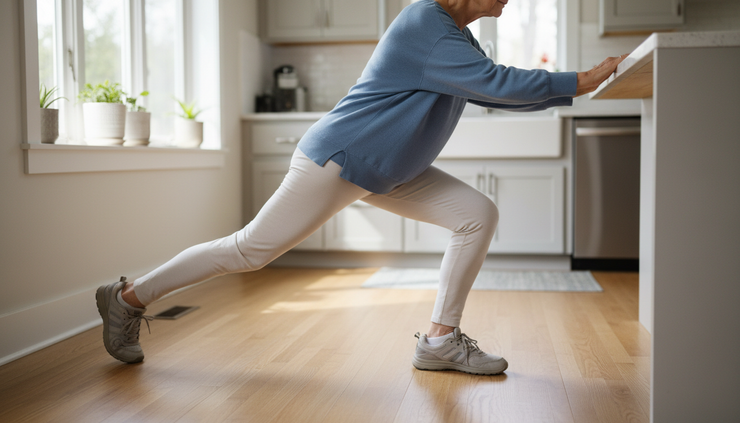
Bird dog at the counter
The floor version of bird dog can be too hard at first. This version is friendlier.
Stand facing a kitchen counter with both hands resting on it. Step back slightly so your body leans forward just a bit.
Tighten your belly gently. Slide one foot back along the floor, then lift it just an inch if that feels okay. Lower and return. Switch sides.
Repeat 5 times per side.
Keep your hips level. The goal is control, not height.
Make each move easier or harder the smart way
The best exercise is the one you can repeat without a flare-up. If a move feels too hard, change it before giving up on it.
Use these simple adjustments.
Make an exercise easier
Do fewer repetitions
Move through a smaller range
Use a chair, wall, or counter for support
Rest longer between moves
Do the exercise seated instead of standing
Skip the move that irritates your back and try again another day
Make an exercise harder
Add 1 or 2 repetitions
Hold the position 1 second longer
Add a second set
Slow the movement down
Use less hand support, only if balance is steady
Change only one thing at a time. If you add reps, don’t also add a longer hold that same day. That makes it harder to know what your back tolerated.
Protect your back during everyday movement
Exercise helps, but daily habits matter too. A back can feel fine during a workout and still get irritated by bending, twisting, or sitting too long.
Use the hip hinge when bending
When reaching into a low cabinet or picking something up, bend at the hips and knees instead of rounding the back.
Try this:
Stand close to the object.
Keep it near your body.
Push your hips back slightly.
Bend your knees.
Use your legs to stand back up.
For small items, a reacher tool can help. There’s no need to prove anything to the laundry basket.
Break up long sitting
Sitting isn’t “bad,” but long stretches can make the back stiff.
Try standing up every 30 to 45 minutes. Walk to the kitchen, do 3 shoulder rolls, or gently march in place while holding a counter.
Small breaks can keep stiffness from building.
Keep loads close
When carrying groceries or laundry, hold items close to your body. Split heavy bags into lighter loads when possible.
A rolling cart can be a back-friendly choice, especially for apartment hallways, parking lots, or longer walks from the car.
Build a weekly routine that doesn’t overwhelm you
You don’t need a complicated plan. A simple rhythm works well.
Try this starter routine 3 days per week:
Warm-up walk
3 to 5 minutes
Seated posture reset
5 repetitions
Pelvic tilts
5 to 10 repetitions
Glute squeezes
8 repetitions
Seated march
5 per side
Counter bird dog
5 per side
Easy walk
2 to 5 minutes
On the other days, take a gentle walk or do light mobility, such as shoulder rolls and weight shifts.
After 2 weeks, check in with your body. If you’re moving more easily and not getting pain flares, add a little. If your back is grumpy, reduce the routine and keep only the easiest moves.
That’s how Gentle Back Strengthening Tips for Seniors Without Extra Pain should feel in real life: manageable, calm, and useful.
Know when to stop and get help
Most mild back stiffness improves with gentle movement, but some symptoms need medical attention.
Stop exercising and contact a health professional if you notice:
New weakness in one leg
Numbness in the groin or saddle area
Loss of bladder or bowel control
Pain after a fall
Fever with back pain
Unexplained weight loss with ongoing pain
Pain that keeps getting worse despite rest and gentle care
Pain that travels below the knee with numbness or tingling
If you already have spinal stenosis, osteoporosis, arthritis, a recent surgery, or a history of fractures, ask your clinician or physical therapist which movements are safest for you.
Small comfort tips that can help
A few details can make back strengthening feel easier.
Wear supportive shoes, even at home. Slippers that slide around can make balance harder.
Exercise on a firm surface. Very soft beds or couches can make movement awkward.
Breathe during every movement. Holding your breath often leads to extra tension in the back and shoulders.
Use heat before movement if stiffness is the main issue. Use cold afterward if the area feels irritated. Keep either wrapped in a towel, and don’t apply extreme temperatures directly to the skin.
Keep a short note after each session. Write down what you did and how your back felt later. Patterns show up quickly.
If you’d like more support building a routine that fits your day, you can explore senior coaching plan options here.
FAQ
How often should seniors do back strengthening exercises?
For many people, 2 to 3 days per week is a good start. Gentle walking or light mobility can be done more often if it feels good. Give your body rest days, especially when starting.
Should I exercise if my back already hurts?
Mild stiffness or low-level discomfort may improve with gentle movement. Sharp pain, spreading pain, numbness, or weakness is different. Stop and get medical advice before continuing.
Are floor exercises required?
No. Many helpful back exercises can be done in a chair, at a wall, or at a kitchen counter. If getting down to the floor feels unsafe, skip floor work.
How long does it take to feel stronger?
Some people feel looser after a few sessions. Strength usually takes longer and builds gradually over weeks. The key is staying consistent without triggering flare-ups.
What’s the best exercise for lower back pain?
There isn’t one best move for everyone. Pelvic tilts, glute squeezes, seated marching, and supported counter exercises are often good starting points because they’re gentle and easy to adjust.

Keep it gentle enough to keep going
The best back routine is one you can return to again and again. Start small. Use support. Stop before pain takes over. Let your body build trust in movement.
A stronger back doesn’t come from forcing it. It comes from steady practice, good pacing, and exercises that leave you feeling a little more capable than before.



Comments