
Is Bicycling Safe for Seniors Best Bike Choices for Bad Knees and Balance

Bicycling can be a great way to stay active later in life, but it also raises fair questions. What if balance isn’t what it used to be? What if knees hurt? What if traffic feels scary? And is a regular bike even the right choice anymore?
The short answer: bicycling can be safe and useful for many seniors, but the best setup matters a lot. For some people, that means a regular upright bike. For others, a 3-wheeled bike, a recumbent bike, or an indoor exercise bike is much safer and more comfortable.
This guide walks through the real-life choices, including bad knees, poor balance, where to ride, helmets, nighttime riding, bike upkeep, and how long to ride for health benefits.
This is general information, not medical advice. If there’s a history of falls, heart problems, dizziness, joint replacement, severe arthritis, or a new health concern, it’s smart to check with a doctor or physical therapist before starting.

Is bicycling safe for seniors?
Yes, it can be. But “safe” depends on the rider, the bike, and the riding environment.
Bicycling is low impact, which means it’s usually gentler on the hips, knees, and ankles than jogging or fast walking on hard pavement. The pedals carry much of the body weight, so the joints don’t take the same pounding.
That said, outdoor biking does carry risks:
Falls
Cars and traffic
Uneven pavement
Getting on and off the bike
Poor visibility
Overdoing it too soon
A good rule is this: the safest bike is the one that matches current strength, balance, confidence, and health. Not the one someone rode 30 years ago. Not the one sitting in the garage. The right bike now may look different, and that’s completely fine.
For many older adults, bicycling works best when it starts small. A quiet parking lot, a park path, an indoor bike, or a paved trail is much better than jumping right into street riding.
The health benefits of riding a bike
Bicycling is a real workout. Yes, it counts as cardio when the pace raises breathing and heart rate. It can also help with leg strength and everyday endurance.
Regular cycling may support:
Heart and lung fitness
Leg strength, especially in the thighs, hips, and calves
Joint movement, which can help with stiffness
Balance and coordination, especially on a regular bike
Mood and stress relief
Healthy weight management, when paired with good nutrition
Stamina for errands, stairs, and walking
It also has a nice bonus: it can feel less like “exercise” and more like getting outside for fresh air.
For people who don’t enjoy gyms or long walks, biking can be a more pleasant way to move. And consistency matters more than intensity. A comfortable 15-minute ride done regularly is better than one exhausting ride that makes someone quit.
What if knees are bad?
Bad knees don’t always rule out bicycling. In fact, many people with knee stiffness prefer cycling because it’s low impact.
But the setup has to be right.
Choose an easy gear
Grinding in a hard gear can strain the knees. A better option is to pedal with light resistance and a steady rhythm. The legs should move smoothly, not push hard with every stroke.
If riding outdoors, use easier gears on hills. If using an indoor bike, keep resistance low at first.
Adjust the seat height
A seat that’s too low can make the knees bend too much and feel sore. A seat that’s too high can cause rocking hips or strain.
A simple check: at the bottom of the pedal stroke, the knee should still have a slight bend. It shouldn’t be locked straight, and it shouldn’t be deeply bent.
Skip steep hills early on
Hills can be rough on knees, especially when starting out. Flat routes are friendlier. Indoor bikes are helpful here because resistance can be controlled minute by minute.
Stop if pain changes
Mild muscle effort is normal. Sharp pain, swelling, locking, or pain that lingers afterward is a signal to stop and get advice from a health professional.
What if balance is poor?
This is where bike choice really matters.
A regular 2-wheeled bike requires balance when starting, stopping, turning, and looking around. That can be too much for someone with dizziness, neuropathy, vision changes, weak legs, or a history of falls.
If balance is a concern, don’t force a regular bike. There are safer options.

Should seniors use a 3-wheeled bike?
A 3-wheeled bike, often called an adult tricycle, can be a very good choice for poor balance. It stays upright when stopped, which makes mounting, dismounting, and pausing much easier.
A trike may be best for someone who:
Feels nervous on a regular bike
Has trouble balancing at slow speeds
Wants to carry groceries or a small bag
Likes a more relaxed pace
Rides mostly on flat paths or quiet streets
But adult trikes have their own learning curve. They handle differently than 2-wheeled bikes. They’re wider, and they can tip if turned too sharply at higher speeds. They also need more storage space.
So yes, a 3-wheeled bike can be safer for balance, but it still takes practice. Start in a flat, open area with no traffic.
Should seniors use an indoor exercise bike?
For many people, an indoor exercise bike is the safest place to start.
There’s no traffic. No potholes. No weather. No dogs running across the path. If balance is poor, an indoor bike removes many fall risks.
Indoor bikes are especially useful for:
Bad weather
Poor balance
Knee arthritis
Low confidence outdoors
Building stamina slowly
Recovering after time away from exercise
There are different types.
Bike type | Best for | Things to know |
Upright stationary bike | A classic bike feel | Takes some balance to get on and off |
Recumbent bike | Back support and easier mounting | Often more comfortable for bad knees or hips |
Under-desk pedal exerciser | Very gentle movement | Less of a full cardio workout, but useful for light activity |
A recumbent bike is often the most comfortable choice. It has a seat with a backrest, and the pedals sit out in front. That can feel easier for people with back pain, hip stiffness, or balance concerns.
Which bike is best?
There’s no single best bike for every older adult. Here’s a simple way to narrow it down.
Situation | Better bike choice |
Good balance and wants outdoor rides | Comfort bike or hybrid bike |
Poor balance but wants outdoors | Adult 3-wheeled bike |
Bad knees and wants control | Indoor stationary bike or recumbent bike |
Back pain or hip stiffness | Recumbent indoor bike |
Wants errands and cargo space | Adult trike with basket |
Fear of traffic or falls | Indoor exercise bike first |
For outdoor riding, a comfort bike is often better than a racing-style bike. Comfort bikes usually have wider seats, upright handlebars, and a more relaxed riding position. That can reduce strain on the back, neck, wrists, and shoulders.
Step-through frames are also helpful. They make it easier to get on and off without swinging a leg high over the bike.
Is it hard to upkeep a bike?
A bike isn’t as complicated as a car, but it does need basic upkeep.
The main things are:
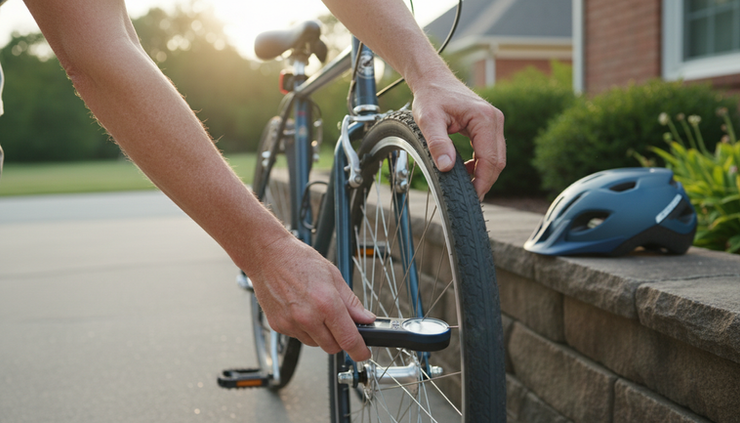
Keeping tires inflated
Checking brakes
Keeping the chain clean and lightly lubricated
Making sure the seat and handlebars don’t wobble
Watching for loose bolts or worn tires
For someone who doesn’t want to deal with maintenance, an indoor exercise bike is usually easier. It still needs occasional cleaning and basic checks, but there are no flat tires from road debris and no outdoor wear from rain.
For an outdoor bike, it’s smart to have a local bike shop do a tune-up once in a while, especially if the bike has been sitting unused in a garage. Old tires, loose brakes, and a rusty chain can make a bike unsafe.
Never assume an old bike is ready to ride just because it looks fine.
Should seniors ride in the street or on the sidewalk?
This depends on local law, traffic conditions, and riding skill.
In many places in the U.S., bicycles are treated as vehicles, which means riders are expected to use the road or bike lane. Some cities allow sidewalk riding in certain areas, while others restrict it. Sidewalk rules can vary, so local laws matter.
From a safety standpoint, here’s the practical breakdown.
Bike lanes and paved trails are usually best
A separated bike path or quiet paved trail is often the safest and most relaxing choice. There are fewer cars, less pressure, and more room to ride slowly.
Quiet residential streets can work
Low-traffic streets may be fine for confident riders. Choose routes with slower speed limits, good visibility, and smooth pavement.
Busy streets are risky
Fast traffic, narrow lanes, parked cars, and intersections all raise the risk. If a route feels stressful, it’s probably not the right route.
Sidewalks can be tricky
Sidewalks may seem safer because they’re away from cars, but they have their own hazards:
Pedestrians
Driveways
Uneven concrete
Curbs
Signposts
Poor visibility at intersections
A 3-wheeled bike can also be too wide for some sidewalks. When bikes are allowed on sidewalks, riders should go slowly and yield to people walking.
Should seniors ride at night?
Night riding is not the best choice for most older adults, especially with slower reaction time, vision changes, balance problems, or unfamiliar routes.
If riding after dark can’t be avoided, use:
A bright white front light
A red rear light
Reflective clothing or ankle bands
Reflectors on the bike
A route with good lighting
Extra caution at intersections
But whenever possible, ride during daylight. Morning or early evening can be great, especially in hot weather. Avoid peak heat, poor visibility, and busy traffic times.
Should seniors wear a helmet?
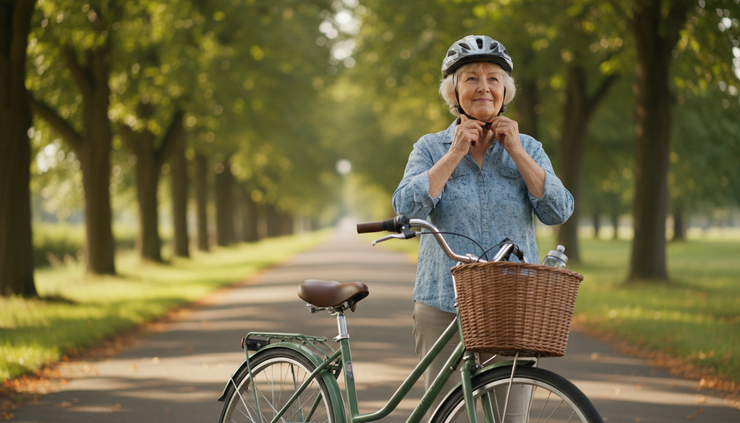
Yes. A helmet is one of the simplest safety steps.
A helmet should sit level on the head, not tilted back. The straps should form a “V” around the ears, and the chin strap should be snug enough that only one or two fingers fit underneath.
Replace a helmet after a crash, even if it doesn’t look badly damaged. Also replace old helmets if the foam is cracked, the straps are worn, or the fit is poor.
Other helpful gear includes:
Closed-toe shoes
Bright or reflective clothing
Padded gloves
A mirror
A bell
Water bottle
ID and emergency contact information
How long should seniors ride for health benefits?
Start lower than you think. That’s the safest way to build the habit.
A good beginner plan might look like this:
Week | Ride length | Effort |
1 | 5 to 10 minutes | Easy |
2 | 10 to 15 minutes | Easy to moderate |
3 | 15 to 20 minutes | Moderate |
4 and beyond | 20 to 30 minutes | Comfortable, steady |
The ride should feel like work, but not punishment. A simple test is the talk test. If it’s possible to talk in short sentences while riding, the pace is usually moderate. If talking is impossible, slow down.
For general health, many adults aim for regular moderate aerobic activity each week. Cycling can count toward that. The exact amount depends on health, ability, and medical guidance.
One more tip: split rides into shorter sessions if needed. Two 10-minute rides can be more realistic than one 20-minute ride.
A simple safety checklist before every ride
Before heading out, take one minute to check the basics.
Tires feel firm
Brakes stop the bike well
Chain moves smoothly
Seat is secure
Helmet fits snugly
Shoes are tied
Phone or ID is carried
Route feels safe
Weather looks reasonable
If anything feels off, fix it before riding. Small problems can become big problems once the bike is moving.

FAQ
Is bicycling a good cardio workout for seniors?
Yes. Cycling can be a cardio workout when it raises breathing and heart rate. Indoor bikes, regular bikes, and adult trikes can all provide cardio benefits if the pace is steady enough.
Is a 3-wheeled bike safer than a regular bike?
It can be safer for balance because it stays upright when stopped. But it’s wider and turns differently, so it still takes practice. Slow turns and flat routes are best at first.
Can biking help strengthen legs?
Yes. Pedaling works the thighs, calves, hips, and glutes. It can help build leg endurance and strength, especially when done regularly with gentle resistance.
Is biking better than walking for bad knees?
Sometimes. Cycling is lower impact than walking, so some people with knee pain find it more comfortable. But poor bike fit or too much resistance can make knee pain worse.
What’s the safest bike for someone afraid of falling?
An indoor recumbent exercise bike is often the safest starting point. For outdoor riding, an adult tricycle may be better than a 2-wheeled bike for someone with balance concerns.
The best choice is the bike that feels safe enough to use
Bicycling can be safe for seniors, and it can be excellent exercise. It supports cardio fitness, leg strength, joint movement, and confidence. But the right choice depends on balance, knees, comfort, and the riding environment.
If balance is poor, start with an indoor bike or adult trike. If knees hurt, use low resistance, adjust the seat, and avoid steep hills. If traffic feels stressful, choose paved trails, quiet streets, or indoor cycling. And yes, wear the helmet.
The goal isn’t to ride fast or far. The goal is to move safely, feel better, and keep doing it.
If extra support would help with fitness planning, safety, or healthy routines, you can view My Senior Coach pricing plans and choose the level of guidance that fits best.


Comments